
Disclaimer: This article may contain affiliate links. As an Amazon Associate, we earn from qualifying purchases at no extra cost to you.
🌍 Note for International Readers: The images in this review feature the US (110V) model. However, our “Check Price” links are smartly geo-targeted. When you click, you will be automatically redirected to the correct local Amazon store (UK, CA, AU) showing the 220V/240V version with your correct local wall plugs.
The 1kWh portable power station category is officially a two-horse race. Just when we thought Anker had completely dominated the market with their insanely fast-charging Gen 2 release, EcoFlow struck back by dropping their highly anticipated next-generation flagship.
If you are currently researching the ultimate ecoflow delta 3 plus vs anker solix c1000 matchup, you are looking at the two absolute best solar generators of 2026.
Both machines have ditched old battery tech for decade-lasting LiFePO4 cells. Both boast wall-charging speeds under one hour, making them the fastest in the world. But when it comes to running heavy kitchen appliances off-grid, which brand actually delivers better real-world performance?
In this comprehensive 2026 showdown, we put both next-gen titans to the test. We will compare the ecoflow delta 3 plus vs anker solix c1000 side-by-side to help you decide which 1kWh beast deserves your hard-earned money.
1. The Cheat Sheet: Next-Gen Specs Compared
Before we dive into our appliance testing for the ecoflow delta 3 plus vs anker solix c1000 debate, let’s look at the raw specifications. The numbers show an incredibly tight battle.
| Feature | EcoFlow DELTA 3 Plus | Anker SOLIX C1000 (Gen 2) |
| 🔋 Capacity | ~1024Wh | 1024Wh |
| ⚡ AC Output | 1800W (3600W Surge) | 2000W (3000W Surge) |
| ⏱️ Charge Time | ~50 Minutes | 49 Minutes |
| ☀️ Solar Input | 1000W | 600W |
| 🧪 Battery | LiFePO4 (3000+ Cycles) | LiFePO4 (3000+ Cycles) |
Need a deeper look at Anker’s new upgrade? Read our hands-on test: Anker SOLIX C1000 Review (Gen 2): Testing the 49-Min Charge
2. Power Output: Which Can Run More Appliances?
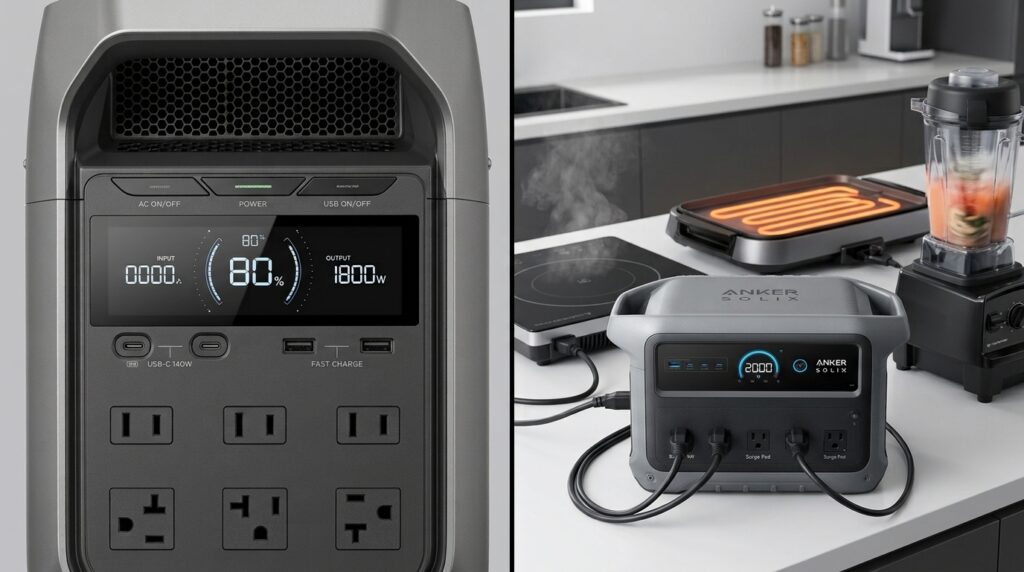
When evaluating pure strength in the ecoflow delta 3 plus vs anker solix c1000 comparison, we have two very different approaches to AC power.
- The Anker Advantage: The Anker SOLIX C1000 Gen 2 outputs an incredibly robust 2000W of continuous power. This means you can comfortably plug in a high-draw microwave and a coffee maker at the exact same time without the inverter crashing.
- The EcoFlow Advantage: The DELTA 3 Plus outputs 1800W. While lower on paper, EcoFlow uses proprietary X-Boost technology. If you plug in a heavy 2200W space heater, the EcoFlow will not shut down; it intelligently lowers the voltage of the appliance to keep it running safely.
- The Winner: For raw, continuous wattage, Anker takes the lead. But for handling unexpected surges effortlessly, EcoFlow’s X-Boost is legendary.
3. Charging Speeds & Solar Off-Grid Recovery
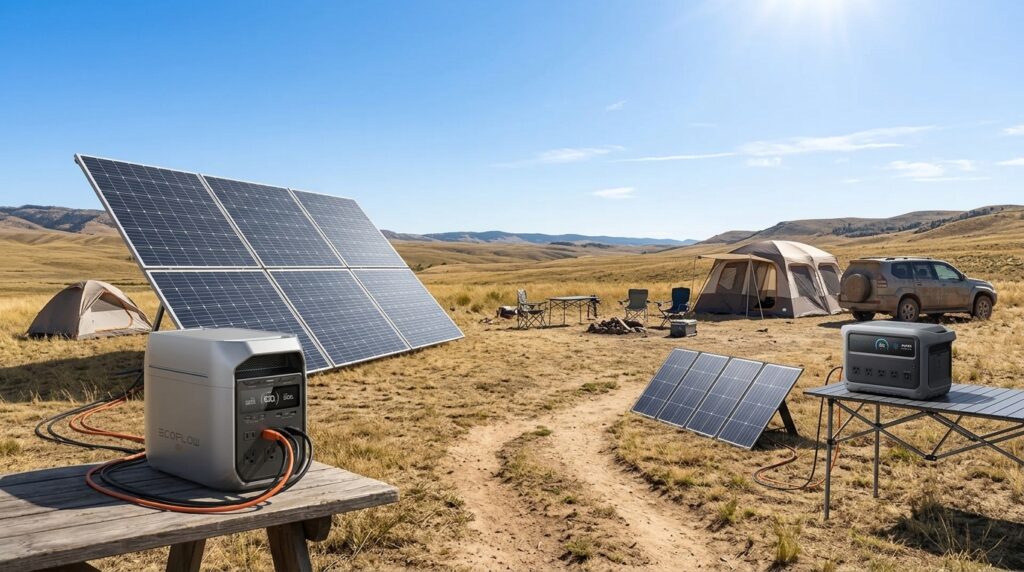
Off-grid recovery speed is the most critical factor in the ecoflow delta 3 plus vs anker solix c1000 battle during a multi-day blackout.
- Wall Charging: Both units are technological marvels here. Anker’s HyperFlash technology recharges the battery from 0-100% in a world-record 49 minutes. EcoFlow’s X-Stream technology follows right behind at roughly 50 minutes. It is a dead tie.
- Solar Charging: This is where the gap widens significantly. The EcoFlow accepts up to a staggering 1000W of solar input. The Anker caps out at 600W. This means the EcoFlow will recharge much faster off-grid if you hook it up to a massive solar array.
Need panels for these machines? Read our tailored guide:
👉 Best Solar Panels for Anker SOLIX C1000 (2026 Guide)
4. Portability and Battery Safety
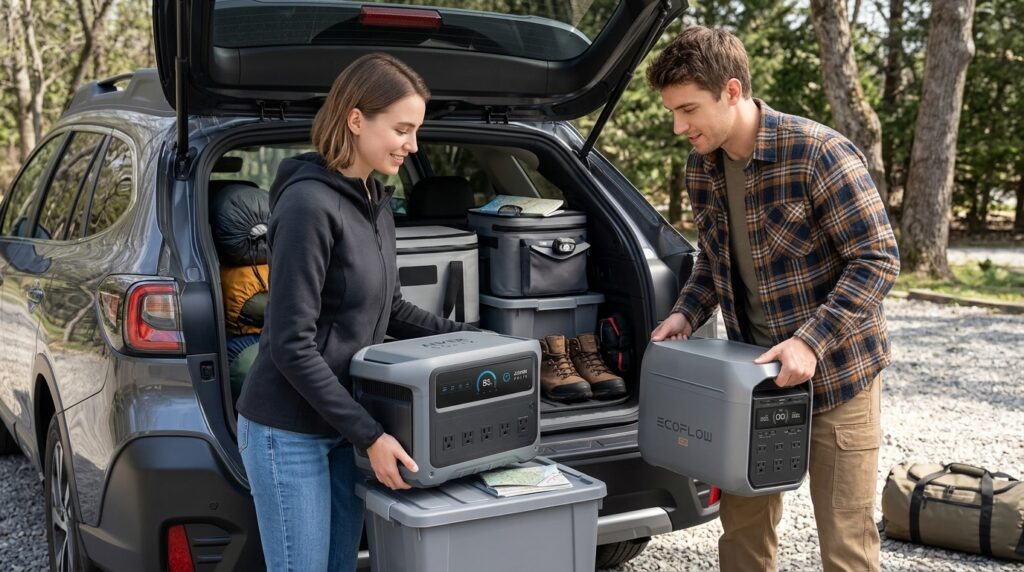
Safety and design are major deciding factors in this ecoflow delta 3 plus vs anker solix c1000 review.
- Battery Chemistry: Both brands use premium Lithium Iron Phosphate cells. According to authoritative chemical research (Wikipedia), LiFePO4 is the safest battery technology on the market, highly resistant to overheating and thermal runaway. Both units will last over a decade.
- Design & Weight: The Anker C1000 weighs around 28.4 lbs and features a brilliant flat-top design, making it very easy to pack in a car trunk. The EcoFlow features its signature modern aesthetic with two sturdy side handles, making it slightly easier for two people to carry over rough terrain.
Final Verdict: Which 1kWh Beast Wins?
To conclude the ultimate ecoflow delta 3 plus vs anker solix c1000 showdown, we must crown a winner based on your lifestyle.
If your primary goal is rapid off-grid recovery and smart app connectivity, the EcoFlow DELTA 3 Plus is the superior choice. Its massive 1000W solar input limit makes it the undisputed king for extended camping trips where sunlight is your only power source.
However, if you want the absolute fastest wall-charging speed (49 minutes), a more compact flat-top design, and a higher 2000W continuous AC output for heavy tools, the Anker SOLIX C1000 (Gen 2) remains a flawless, high-value investment.
Want to see how these units compare to another trusted brand? Check out: EcoFlow DELTA 3 Plus vs Jackery Explorer 1000 v2 (2026 Battle).
FAQ
Which is better for UPS home backup in the ecoflow delta 3 plus vs anker solix c1000 debate?
Both units act as excellent Uninterruptible Power Supplies (UPS) with a 20ms switchover time. If the grid fails, they automatically switch to battery power, ensuring your desktop PC or medical CPAP machine stays on without interruption.
Can I expand the battery capacity in the ecoflow delta 3 plus vs anker solix c1000 comparison?
Yes. A great feature of both systems is that they support expansion batteries. You can buy their respective extra battery packs and plug them in directly, instantly doubling your capacity to over 2000Wh for extended outages.
Can I use third-party solar panels on both machines?
Yes, absolutely. To maximize your savings in the ecoflow delta 3 plus vs anker solix c1000 competition, you can use cheaper third-party panels (like Renogy). You just need an MC4 to XT60 adapter for the Anker, and an MC4 to XT60i adapter for the EcoFlow.