
Disclaimer: This article may contain affiliate links. As an Amazon Associate, we earn from qualifying purchases at no extra cost to you.
Welcome to our in-depth EcoFlow 110W solar panel review. When buying a portable panel, the choice often comes down to two big names: EcoFlow vs. Jackery. While our previous Jackery SolarSaga 100W review showed why it is so popular, the EcoFlow 110W claims to be more durable.
But is it actually better?
In this comprehensive EcoFlow 110W solar panel review for 2026, we put it to the test. We analyze its build quality, real-world output, and whether it deserves a spot in your camping gear.
1. Design & Build Quality (IP68 Rating)
The biggest selling point of the EcoFlow 110W is its toughness.
- Waterproof: Unlike Jackery (IP65), the EcoFlow is rated IP68. You can submerge it in water for 30 minutes, and it will still work.
- The Case: It comes with a kickstand case. While clever, it can be a bit “floppy” compared to Jackery’s magnetic legs.
This durability is a key factor in our EcoFlow 110W solar panel review rating.
2. Real-World Efficiency Test
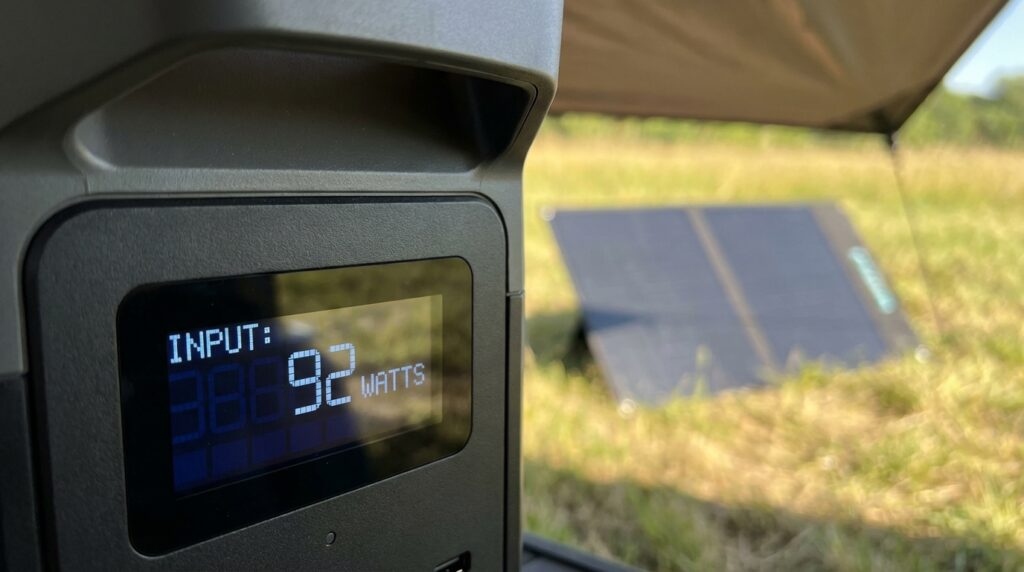
Rated 110W doesn’t mean you get 110W. We tested it in direct sunlight.
- Peak Output: We consistently saw 85W – 95W on a clear day.
- Efficiency: It uses Monocrystalline cells with ~23% efficiency, which is top-tier for portable panels.
- Compatibility: It uses the standard MC4 connector, making it compatible with almost any power station (Bluetti, Anker) with an adapter.
Need a bigger setup? If 110W isn’t enough, check our guide on How to Choose Portable Solar Panels for Camping.
3. Pro Tips: How to Get the Full 110W?
Getting the maximum output from any solar panel requires a bit of skill. Here is how to squeeze every watt out of the EcoFlow 110W:
- The 90-Degree Rule: Always angle the panel so it is perfectly perpendicular to the sun rays. If the sun is overhead, lay it flat. If it is evening, tilt it up.
- Avoid Shadows: Even a small shadow from a leaf covering one cell can drop the efficiency of the entire panel by 50%.
- Keep it Clean: Dust and pollen block UV rays. Wipe the surface with a damp cloth before connecting it to your power station.
4. Comparison: EcoFlow 110W vs. Jackery SolarSaga 100W
This is the battle everyone wants to see.
| Feature | EcoFlow 110W | Jackery SolarSaga 100W |
| Rated Power | 110W | 100W |
| Waterproof | Yes (IP68) 🏆 | Water Resistant (IP65) |
| Kickstand | Zip Case (Tricky) | Built-in Legs (Easy) 🏆 |
| USB Ports | No | Yes (USB-A/C) 🏆 |
| Connector | Universal MC4 | Proprietary 8mm |
- Verdict: Buy EcoFlow if you need rugged durability and waterproofing. Buy Jackery if you want the easiest setup with built-in USB charging.
5. Pros and Cons
To summarize this EcoFlow 110W solar panel review, here are the main pros and cons.
✅ The Good:
- Fully waterproof (Dust & Water tight).
- Universal MC4 connectors (Works with everything).
- High efficiency cells.
- Compact and foldable design.
❌ The Bad:
- The “Case Stand” is fiddly to set up.
- No direct USB ports for charging phones without a battery.
6. EcoFlow 110W Solar Panel Review Verdict: Should You Buy It?
To wrap up our EcoFlow 110W solar panel review, the answer depends on where you camp.
If you are a serious van lifer or live in the Pacific Northwest where rain is unpredictable, this panel is the winner. Its IP68 waterproof rating gives you peace of mind that a sudden storm won’t ruin your investment.
However, if you just want a simple panel for sunny weekend trips and want to save some money, the Jackery SolarSaga might be slightly easier to use.
FAQ
Q: Can I connect two EcoFlow 110W panels together?
A: Yes! You can chain them in series or parallel to get 220W, speeding up your charging time significantly for larger batteries like the DELTA 2.
Q: Does it work with Jackery power stations?
A: Yes, but you will need an “MC4 to 8mm Adapter”. The panel itself produces energy that any battery can use if the plug fits.
Q: Is it bifacial (double-sided)?
A: No, the 110W model is single-sided. EcoFlow’s 220W model is the bifacial one.