
Disclaimer: This article may contain affiliate links. As an Amazon Associate, we earn from qualifying purchases at no extra cost to you.
🌍 Note for International Readers: The images in this review feature the US (110V) model. However, our “Check Price” links are smartly geo-targeted. When you click, you will be automatically redirected to the correct local Amazon store (UK, CA, AU) showing the 220V/240V version with your correct local wall plugs.
The Anker Solix C1000 is widely considered one of the fastest-charging portable power stations of 2026. While its ability to charge from a wall outlet in just 58 minutes is mind-blowing, taking this 1056Wh powerhouse off-grid requires a completely different strategy. To unlock its true potential in the wild, you need the best solar panel for Anker Solix C1000.
Anker designed the C1000 with a massive 600W solar input capacity, which is higher than most competitors in the 1kWh class (like the EcoFlow DELTA 2 or Jackery 1000 v2).
However, you can’t just plug any random solar array into it. Exceeding the strict voltage limits will trigger the Battery Management System (BMS) to shut down—or worse, fry the inverter.
Should you stick to Anker’s premium native panels, or can you save money by adapting third-party brands like EcoFlow or Renogy?
In this 2026 technical guide, we break down the exact solar limits, the best panel combinations to hit that 600W max, and the specific adapter cables you need.
1. The Cheat Sheet: Anker Solix C1000 Solar Limits
Before spending hundreds of dollars on solar panels, you must memorize the MPPT limits of the C1000. If your solar array exceeds the “Max Voltage (Voc)”, the power station will not accept the charge.
| Specification | The Solix C1000 Limit | What It Means For You |
| Max Solar Input | 600 Watts | The unit will not draw more than 600W, even if you connect 800W of panels. |
| Voltage Limit (Voc) | 11V – 60V | Do not wire too many panels in “Series,” or you will exceed the 60V limit and trigger a fault. |
| Input Port Type | XT60 | This is the industry standard! It makes adapting third-party panels incredibly easy. |
Still learning about this power station? Read our full breakdown: Anker Solix C1000 Review: Better Than EcoFlow DELTA 2?
2. Best Overall (Native): Anker SOLIX PS400 (400W Panel)
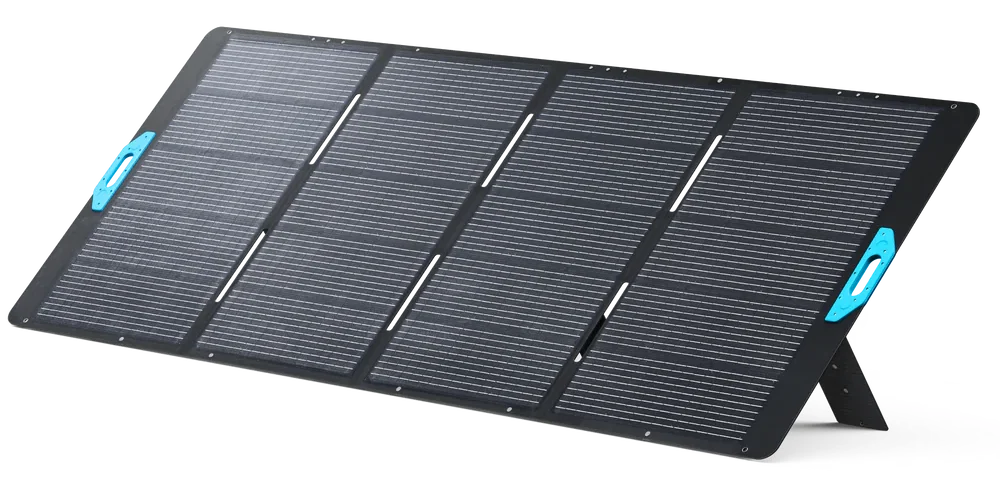
If you want a flawless, plug-and-play experience without messing with adapters or messy cables, the Anker SOLIX PS400 is hands down the best solar panel for Anker Solix C1000.
- Why it wins: It is a beast. This single, foldable panel generates 400W of power with an impressive 23% conversion efficiency. It is built specifically to pair perfectly with the C1000’s XT60 port. It’s also IP67 waterproof, meaning it can survive harsh weather during your RV trips.
- The Setup: Plug it directly into the C1000 using the included XT60 cable. It’s that simple.
- Charge Time: With one PS400, you can recharge the C1000’s 1056Wh battery from 0% to 100% in about 2.5 to 3 hours of prime sunlight.
3. Best for Versatility: EcoFlow 220W Bifacial Panel
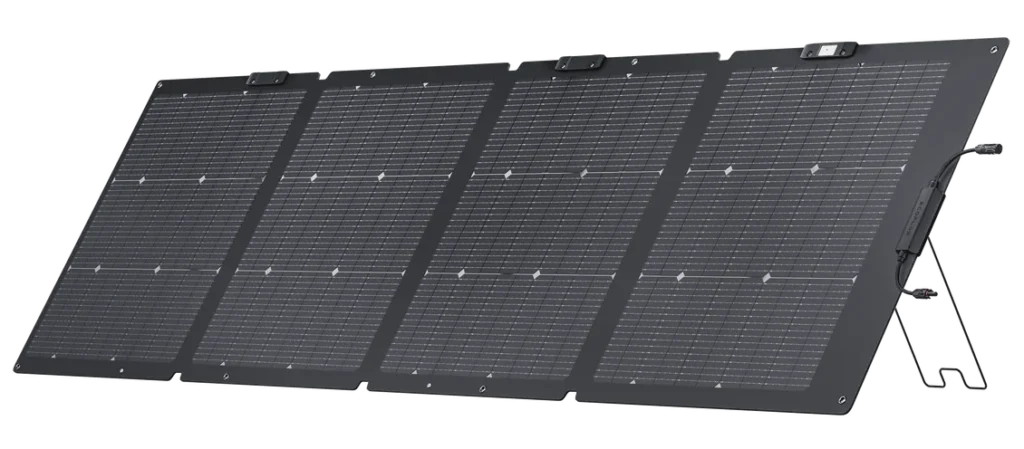
What if you want to get closer to the 600W maximum limit but want panels that are lighter to carry? The EcoFlow 220W Bifacial is a brilliant third-party option that works flawlessly with Anker.
- Why it wins: EcoFlow uses the exact same XT60 connector as Anker, meaning these panels are natively compatible! Furthermore, this panel is “Bifacial”—it captures sunlight from the front (220W) and ambient light from the back (up to 155W), making it highly efficient on cloudy days.
- The Setup: You can connect TWO of these panels in “Parallel” using an XT60 Parallel Splitter. This gives you a massive 440W+ array while keeping the voltage safely under the 60V limit.
- Charge Time: Two 220W panels will recharge your Anker Solix C1000 in roughly 2 to 2.5 hours.
Curious how EcoFlow power stations compare to Anker? Read our showdown:Anker Solix C1000 vs EcoFlow DELTA 2.
Pro Tip: EcoFlow frequently runs massive flash sales on this panel (we’ve seen it drop by up to 58%!). Click the button below to see if you can catch today’s deal.
4. Best Budget (Rigid): Renogy 200W Solar Panel
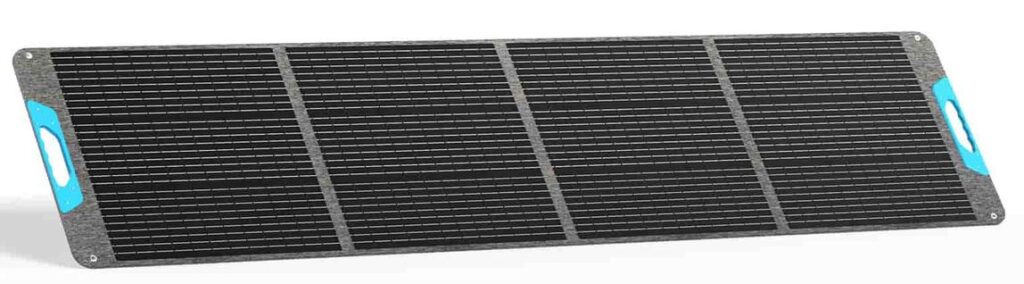
Foldable fabric panels are expensive. If you are mounting panels on an RV roof, a van, or a shed, rigid glass panels are much cheaper. The Renogy 200W Monocrystalline Panel is the ultimate budget choice.
- Why it wins: You get massive 200W of reliable solar power for significantly less than premium brands. It features a durable, foldable design, an IP65 waterproof rating, and a protective storage bag.
- The Setup: To hit near the 600W limit, you can wire two of these panels in “Series” (this keeps the voltage around 45V, safely under the 60V limit).
- Note: These panels use standard MC4 connectors. To plug them into your Anker C1000, you will need a simple MC4 to XT60 Adapter Cable. (We explain exactly why this is needed in the section below).
Adapter Guide: If you are confused about wiring, we explain series vs. parallel here: How to Connect a Solar Panel to a Portable Power Station.
5. The XT60 Advantage: Why Anker is Easy to Adapt
As mentioned, Anker’s XT60 port is the universal standard for portable power. Unlike proprietary 8mm ports that “trap” you in their expensive ecosystem, the XT60 standard allows you to use almost any reliable solar panel on Amazon.
Important: If you choose a third-party panel (like Renogy, HQST, or BougeRV), ensure you have an MC4 to XT60 Adapter Cable in your cart. It is an inexpensive, essential piece of gear that bridges the connection between standard solar panels and your Anker C1000, ensuring your setup works the moment it arrives at your campsite.
The Bottom Line: Don’t let proprietary cables limit your off-grid freedom. Whether you choose the premium Anker SOLIX PS400 for its ease of use, or a budget-friendly Renogy panel with an adapter, the C1000 is ready for it.
When researching the best solar panel for Anker Solix C1000, many users forget that cable length and connector type are just as important as the panel’s wattage. High-quality cables ensure you don’t lose precious energy during the transfer from the panel to your power station.
How to Choose the Best Solar Panel for Anker Solix C1000
Finding the best solar panel for Anker Solix C1000 comes down to your budget and how fast you need to recharge. The Anker SOLIX PS400 offers unbeatable convenience for native setups, while pairing two EcoFlow 220W Bifacial panels is a brilliant loophole for faster solar speeds.
If you are still deciding between brands, see how the Anker holds up against its biggest rival in our showdown: Jackery Explorer 1000 v2 vs. Anker Solix C1000: Battle of the Titans.
In summary, choosing the best solar panel for Anker Solix C1000 depends on whether you prioritize portability or budget, and this decision ultimately pays off in much faster charge times during your camping trips.
FAQ
Q: Can I connect 800W of solar panels to my Anker Solix C1000?
A: Yes, this is called “Overpaneling.” As long as you do not exceed the 60V limit, connecting 800W of panels is perfectly safe. The Anker’s MPPT controller will simply cap the power draw at its 600W maximum. Overpaneling is actually recommended to ensure you hit 600W even on cloudy days.
Q: Why is my Anker Solix C1000 charging so slowly from solar?
A: Solar panels rarely output their rated wattage due to atmospheric conditions. Ensure your panel is angled directly at the sun without any shadows (even a shadow from a small branch can cut power by 50%). Also, check the Anker App to ensure you haven’t accidentally limited the input speed in the settings.
Q: What is the best solar panel for Anker Solix C1000?
A: As we mentioned, for overall performance, the Anker PS400 is the top choice.