
Disclaimer: This article may contain affiliate links. As an Amazon Associate, we earn from qualifying purchases at no extra cost to you.
Buying a battery is only half the battle. To truly go off-grid, you need the right portable solar panels for camping.
But with options ranging from 60W to 400W, how do you know which one fits your battery? Buy too small, and you never reach 100%. Buy too big, and you waste money.
In this 2026 guide, we simplify the math. We will help you pair the perfect panel with your power station, whether you have a small Jackery 300 or a massive EcoFlow DELTA.
1. The “Golden Ratio”: Battery vs. Panel
The biggest mistake beginners make is thinking “Bigger is always better.”
Most power stations have a limit on how much solar input they can handle (Input Voltage Limit).
- The Rule of Thumb: Aim for a panel that can recharge your battery in 4-6 hours of peak sunlight.
- The Formula: (Battery Capacity Wh) ÷ 4 Hours = Ideal Panel Wattage.
2. Sizing Guide: What Size Do I Need?
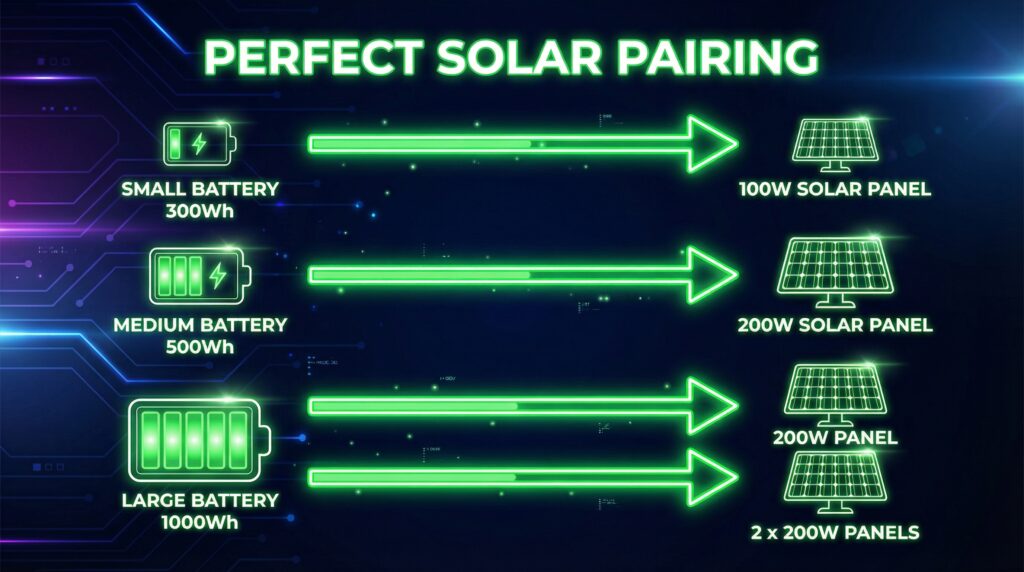
Based on the “Golden Ratio,” here is the perfect pairing for the most common batteries:
- For 300Wh Batteries (e.g., Jackery 300):
- Ideal Panel: 100W.
- Charge Time: ~3-4 Hours.
- Note: A 60W panel is too slow (6+ hours).
- For 500Wh Batteries (e.g., EcoFlow RIVER 2 Max):
- Ideal Panel: 160W – 200W.
- Charge Time: ~3-4 Hours.
- Note: A 100W panel is acceptable but slow (6-8 hours).
- For 1000Wh Batteries (e.g., Jackery 1000):
- Ideal Panel: 2x 100W or 1x 200W.
- Charge Time: ~6-8 Hours.
Need to calculate your battery size first? Check our calculator guide: What Size Portable Power Station Do I Need?.
3. Rigid vs. Portable (Foldable)
Not all portable solar panels for camping are built the same.
- Foldable (Fabric): Best for hikers and weekend campers. They are lightweight and fit in a car trunk. (Example: Jackery SolarSaga).
- Rigid (Glass/Frame): Best for RV roofs or permanent van builds. They are cheaper and durable but heavy.
4. The “Real World” Output Warning
If you buy a 100W panel, will you get 100W? No.
- Reality Check: Expect about 70-80% of the rated power on a good day.
- Factors: Clouds, angle of the sun, and heat all reduce efficiency.
- Tip: Always angle your panel directly at the sun and move it every 2 hours.
Deep Dive: Want to see a real-world test? Read our review of the most popular model: Jackery SolarSaga 100W Review.
5. Top 3 Picks for 2026
If you want reliable power without the guesswork, here are the top-rated panels:
- Jackery SolarSaga 100W: The industry standard. Durable and efficient.
2. EcoFlow 160W Panel: Waterproof (IP68) and powerful.
3. Renogy 100W Suitcase: Affordable and rugged.
Conclusion
Choosing the right portable solar panels for camping doesn’t have to be complicated. Just match the panel wattage to your battery size (aim for a 4-hour charge), and you will never run out of power.
For more tips on staying powered up outdoors, check our guide on What Can a 500W Portable Power Station Run?.
FAQ
Q: Can I use any solar panel with any power station?
A: Mostly yes, BUT you must check the “Input Voltage” (Voc). Never exceed the max voltage of your battery, or you will fry the controller.
Q: Do solar panels work in the shade?
A: Barely. A small shadow from a tree branch can drop the output by 80%. They need direct sunlight.
Q: Are portable solar panels waterproof?
A: Most are “Water Resistant” (IP65) meaning they can handle light rain, but you shouldn’t leave them out in a storm.