
Disclaimer: This article may contain affiliate links. As an Amazon Associate, we earn from qualifying purchases at no extra cost to you.
🌍 Note for International Readers: The images in this review feature the US (110V) model. However, our “Check Price” links are smartly geo-targeted. When you click, you will be automatically redirected to the correct local Amazon store (UK, CA, AU) showing the 220V/240V version with your correct local wall plugs.
Let’s be real. If you are shopping for a portable power station in late 2026, you are likely stuck in the middle of the Jackery 1000 v2 vs EcoFlow DELTA 2 battle. You aren’t looking for obscure brands; you are staring at these two titans.
These are the titans of the 1kWh class. They cost roughly the same, they both use long-lasting LiFePO4 batteries, and they both promise to keep your lights on.
But here is what the spec sheets won’t tell you: They are built for two completely different types of people.
After testing the updated “v2” form factor of the Jackery against the feature-packed EcoFlow, the choice became obvious. One is a camping masterpiece; the other is a home backup beast. Let’s break down the battle of Jackery 1000 v2 vs EcoFlow DELTA 2 so you don’t buy the wrong one.
At a Glance: The “Cheat Sheet” Comparison
If you are in a rush to see the main specs, here is the raw Jackery 1000 v2 vs EcoFlow DELTA 2 comparison data side-by-side.
| Feature | Jackery Explorer 1000 v2 | EcoFlow DELTA 2 |
| Capacity | 1070Wh | 1024Wh (Expandable to 3kWh) |
| AC Output | 1500W | 1800W (2700W Surge) |
| Battery Life | 4,000 Cycles (LiFePO4) | 3,000 Cycles (LiFePO4) |
| Portability | Excellent (Foldable Handle) | Good (Rigid Handles) |
| Charging Speed | 1 Hour (Emergency Charge) | 50-80 Minutes |
| Best Feature | Simplicity & Compact Size | X-Boost & Expandability |
| Ideal User | Campers & Travelers | Home Backup & Techies |
Summary of the Jackery 1000 v2 vs EcoFlow DELTA 2 technical specifications.
Round 1: Design & Portability (The “Trunk Test”)
This is the biggest physical difference.
The Jackery 1000 v2 feels like it was designed by someone who actually goes camping. It is noticeably compact. The handle finally folds flat (unlike the old 1000 Pro), meaning you can stack boxes on top of it in your car trunk. It weighs about 23.8 lbs, which is easy enough for most adults to carry with one hand.
The EcoFlow DELTA 2 has those signature “wings” (rigid handles) sticking out the front and back. While they protect the cables, they make the unit awkward to pack. You can’t put anything on top of it. It’s also slightly heavier at 27 lbs.
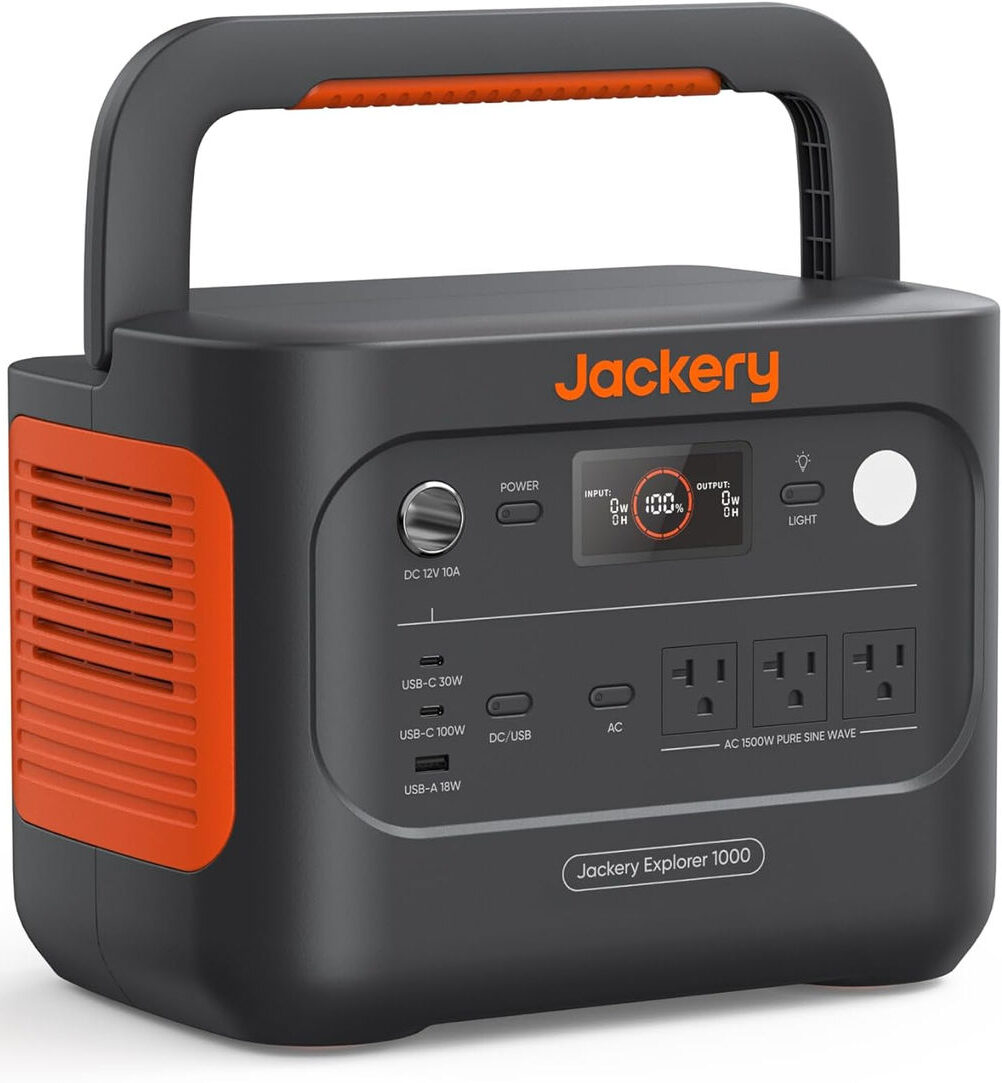
🏆 Winner: Jackery. For life on the road, the form factor is superior.
Round 2: Power Output & “X-Boost”
Do you need to run high-wattage appliances like a microwave, hair dryer, or a table saw?
- Jackery 1000 v2: Provides 1500W continuous power. This handles 90% of household goods, but it might trip if you plug in a heavy-duty heater on max setting.
- EcoFlow DELTA 2: Provides 1800W continuous, but it has a secret weapon: X-Boost. This allows it to power devices up to 2200W-2700W by lowering the voltage. It doesn’t truly “run” them at full power, but it stops the overload protection from tripping.
🏆 Winner: EcoFlow. It simply has more muscle for hungry appliances.
Round 3: Expandability (The Dealbreaker)
This is the most critical section of this review.
The EcoFlow DELTA 2 is expandable. If 1024Wh isn’t enough, you can buy an extra battery and plug it in, doubling (or tripling) your capacity up to 3kWh. This is huge for home backup during long blackouts.
The Jackery 1000 v2 is a standalone unit. What you buy is what you get. You cannot chain extra batteries to it. If you run out of power, you have to recharge.
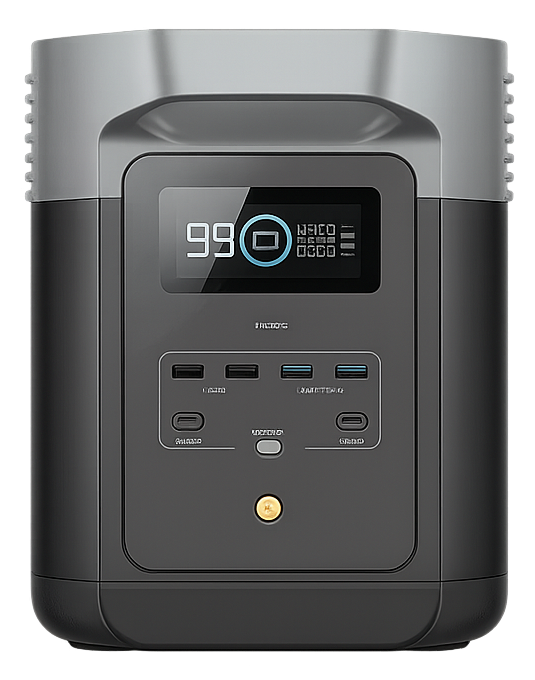
🏆 Winner: EcoFlow. For home backup, expandability is king.
Round 4: User Experience & App
EcoFlow’s App is widely considered the gold standard in the industry. You can control charging speeds, set discharge limits, and view real-time graphs via Wi-Fi or Bluetooth. It feels like a modern tech product.
Jackery has updated their app, and it works fine for basic monitoring. However, the unit itself is designed for “Plug and Play” simplicity. You don’t need the app to use it. The buttons are tactile, the screen is bright, and the interface is intuitive.
🏆 Winner: Tie. EcoFlow wins for tech-heads; Jackery wins for simplicity (ideal for seniors or non-tech users).
Jackery 1000 v2 vs EcoFlow DELTA 2: Final Verdict
These are both 5-star products in 2026, but they serve different masters.
(If these units feel too heavy or expensive for your needs, check out our comparison of the lighter Jackery Explorer 300 Plus vs EcoFlow RIVER 2).
✅ Buy the Jackery Explorer 1000 v2 if:
- You prioritize size: You need something that packs easy for camping trips.
- You want simplicity: You hate fiddling with apps and settings.
- You want battery longevity: It claims 4,000 cycles (slightly higher than EcoFlow).
✅ Buy the EcoFlow DELTA 2 if:
- You need Home Backup: The ability to add extra batteries later is invaluable.
- You use heavy tools: The 1800W output + X-Boost handles much more load.
- You want fast UPS: It switches to battery power faster (<30ms) when the grid fails.
Frequently Asked Questions (FAQ)
1. Can I leave these plugged in all the time?
Yes. Both units have BMS (Battery Management Systems) that prevent overcharging. However, for long-term storage, it’s best to discharge them to 60-80% every few months.
2. Which solar panel should I get?
For the Jackery 1000 v2, the new SolarSaga 100W Air is the perfect match for portability (Read our full Jackery SolarSaga 100W Air Review). However, to hit the max 400W solar speed, we recommend a pair of 200W panels. For EcoFlow, any universal panel with an XT60i connector works great.
3. Is the fan noise loud?
The Jackery 1000 v2 is surprisingly quiet (under 30dB in silent mode), making it ideal for sleeping. The EcoFlow DELTA 2 can get a bit loud—resembling a gaming laptop—when charging at max speed, but you can lower the charging speed via the EcoFlow app to silence it.
4. Jackery 1000 v2 vs EcoFlow DELTA 2: Which charges faster?
While the EcoFlow DELTA 2 used to be the speed king, the gap has closed. The Jackery 1000 v2 now charges in just 1 hour, making it nearly as fast as the EcoFlow (50-80 mins).
Pingback: EcoFlow DELTA 2 Max vs Jackery 2000 Plus: The Ultimate 2kWh Showdown (2026)