
Disclaimer: This article may contain affiliate links. As an Amazon Associate, we earn from qualifying purchases at no extra cost to you.
Choosing the winner in this Jackery Explorer 1000 v2 vs Anker Solix C1000 comparison is tough. The 1kWh portable power station market has never been more competitive. In one corner, we have the refreshed legend from Jackery. In the other, the tech-heavy challenger from Anker.
Both use safe LFP batteries. Both charge in under an hour. Both cost roughly the same.
But they are built for two very different users.
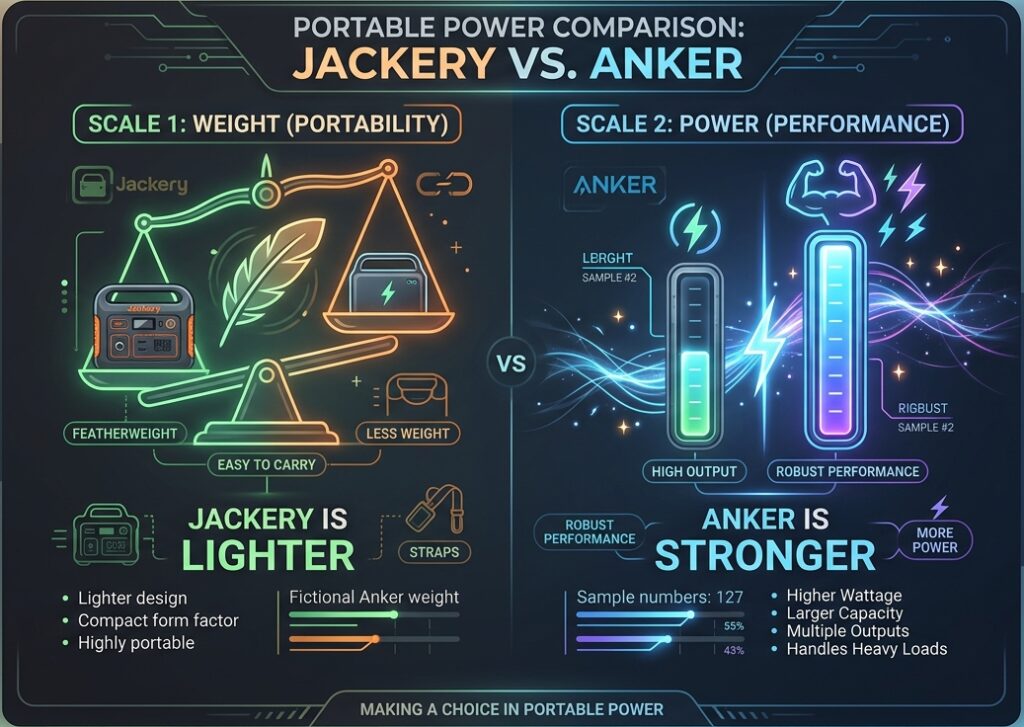
- Jackery focused on making it light.
- Anker focused on making it strong.
In this Jackery Explorer 1000 v2 vs Anker Solix C1000 showdown, we help you decide which one belongs in your gear.
1. Portability: The Back-Saving Test
If you plan to carry your station from the car to the campsite, this section decides the winner immediately.
- Jackery 1000 v2: Weighs 23.8 lbs (10.8 kg). It is shockingly light for its capacity. The handle folds flat, making it easy to pack.
- Anker Solix C1000: Weighs 28.4 lbs (12.9 kg). While 5 lbs doesn’t sound like much, you feel it after walking 100 yards.
- Winner: Jackery. It is the undisputed king of portability in this class.
2. Inverter Power: Running Heavy Appliances
When testing the jackery explorer 1000 v2 vs anker solix c1000 for running high-wattage appliances, the results were clear.
- Jackery: 1500W Output. It handles coffee makers and fridges easily, but might trip with a large space heater.
- Anker: 1800W Output (2400W SurgePad). With its “SurgePad” tech, Anker can run devices up to 2400W without overloading.
- Winner: Anker. It is a beast for heavy-duty appliances.
Deep Dive: See the full capabilities in our individual reviews:
3. Expandability: Growing With Your Needs
Expandability is a massive difference that many buyers overlook when comparing the jackery explorer 1000 v2 vs anker solix c1000.
- Jackery 1000 v2: It is a standalone unit. You cannot expand it. What you buy is what you get (1070Wh).
- Anker Solix C1000: It is modular. You can plug in an Anker BP1000 expansion battery to double the capacity to 2112Wh.
- Winner: Anker. If you think you might need more power later for a home blackout, Anker is the smarter investment.
4. Charging Speed (The Race)
Another crucial factor in the jackery explorer 1000 v2 vs anker solix c1000 debate is charging speed. Let’s look at the real-world numbers.
- Anker: 0-100% in 58 minutes (HyperFlash).
- Jackery: 0-100% in 1 hour (Emergency Charge Mode).
- Verdict: It is virtually a Tie. Both are lightning fast compared to older models.
5. UPS Function (Home Office)
If you are buying this to keep your WiFi router or PC running during storms:
- Anker: Has a true UPS with <20ms switchover time.
- Jackery: Has Pass-through charging, but isn’t rated as a sub-20ms UPS for sensitive servers.
- Winner: Anker.
Final Verdict: Which One Wins?
To conclude this Jackery Explorer 1000 v2 vs Anker Solix C1000 battle, the choice comes down to one question: Are you moving it, or parking it?
Choose the Jackery 1000 v2 If:
You are a camper, beach-goer, or road-tripper. The lightweight design and rugged build make it the ultimate travel companion.
Choose the Anker Solix C1000 If:
You want a home backup solution or need to run heavy tools. The expandable capacity, UPS mode, and higher inverter output make it a mini-powerhouse for the home.
FAQ
Q: Which one is quieter?
A: The Jackery 1000 v2 is marketed as “Whisper Quiet” (30dB). The Anker fans can be a bit more aggressive during fast charging.
Q: Can I use 400W solar panels on them?
A: Yes. The Anker accepts up to 600W solar input, while the Jackery accepts up to 400W. Both work great with big panels.
(See: What Can a 400W Solar Panel Run?)
Q: Do they use LFP batteries?
A: Yes, both models have upgraded to LiFePO4 batteries, rated for 3,000+ cycles (10 years of life).