
Disclaimer: This article may contain affiliate links. As an Amazon Associate, we earn from qualifying purchases at no extra cost to you.
🌍 Note for International Readers: The images in this review feature the US (110V) model. However, our “Check Price” links are smartly geo-targeted. When you click, you will be automatically redirected to the correct local Amazon store (UK, CA, AU) showing the 220V/240V version with your correct local wall plugs.
If you are looking for an ultra-lightweight, budget-friendly portable power station for weekend camping, Jackery is undoubtedly the first brand that comes to mind. However, their current lineup has left many buyers incredibly confused.
With the release of the newer “Plus” generation, many expected the classic Explorer 300 to be discontinued. Instead, Jackery secretly upgraded the battery chemistry of the classic model and kept it on the market, creating a massive jackery 300 vs 300 plus dilemma for consumers.
Both devices hover around the same 300-watt-hour capacity, both use incredibly safe LiFePO4 batteries, and both cost roughly the same. So, which one actually deserves your hard-earned money?
In this comprehensive 2026 showdown, we put both models to the ultimate off-grid test. We will compare the jackery 300 vs 300 plus side-by-side to reveal the hidden differences in portability, smart features, and output capabilities.
1. The Cheat Sheet: Specs Compared
Before we analyze real-world appliance performance for the jackery 300 vs 300 plus debate, let’s look at the raw specifications. The numbers show two very capable but distinctly different machines.
| ⚙️ Feature | Classic Jackery 300 | Jackery 300 Plus |
| 🔋 Capacity | 292Wh | 288Wh |
| ⚡ AC Output | 300W (500W Surge) | 300W (600W Surge) |
| 🧳 Handle Design | Solid Molded Handle | Folding Flat Handle |
| 📱 Smart App | No | Yes (Bluetooth/Wi-Fi) |
| 🧪 Battery Type | LiFePO4 (LFP) | LiFePO4 (LFP) |
| ⚖️ Weight | 7.1 lbs (3.2 kg) | 8.27 lbs (3.75 kg) |
Need a deeper look at the classic model? Read our standalone guide: Jackery Explorer 300 Review (2026): The Secret LFP Upgrade?
2. Portability and Design Differences

The most noticeable physical difference in the jackery 300 vs 300 plus comparison is how you pack and carry them.
- The Classic 300: This unit features Jackery’s iconic solid, molded handle. It weighs a remarkably light 7.1 lbs, making it the effortless champion for quick grab-and-go trips. However, the fixed handle means you cannot stack anything on top of it in your car trunk.
- The 300 Plus: Jackery modernized the design by adding a flat folding handle. This allows you to safely stack other camping gear or bags on top of the unit, saving vital space. The trade-off? It weighs slightly more at 8.27 lbs.
3. Power Output & Smart Features
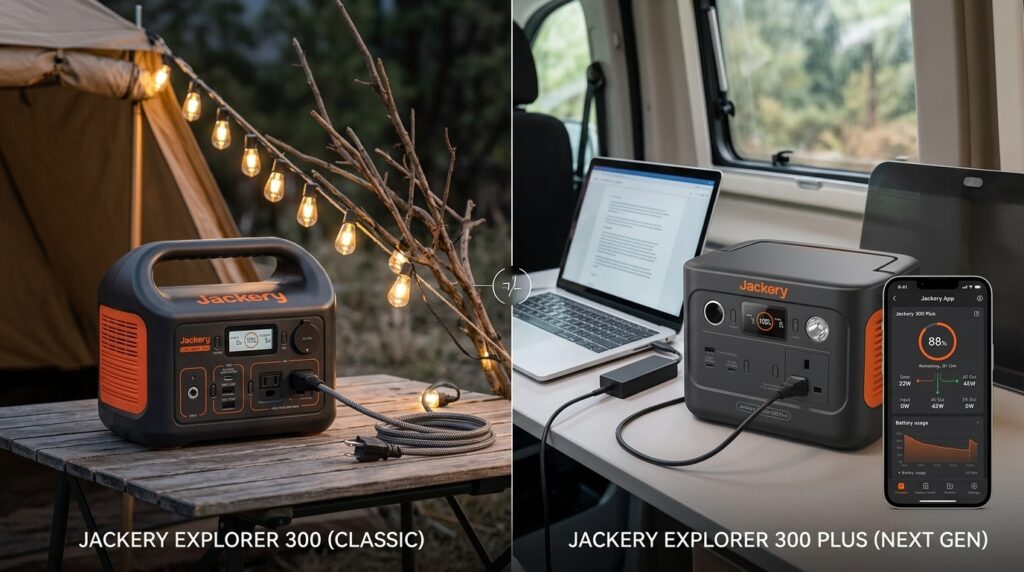
When evaluating raw performance in the jackery 300 vs 300 plus battle, both deliver 300W of continuous power, but the newer model has a few technological tricks up its sleeve.
- Surge Power: The 300 Plus handles a 600W peak surge, giving it a slight edge over the classic model’s 500W surge when starting small motors or fans.
- App Connectivity: The biggest technological leap is the smartphone app. The 300 Plus connects via Wi-Fi and Bluetooth, allowing you to monitor your battery percentage, control output ports remotely, and adjust charging settings from your tent. The classic 300 has no app connectivity.
- EPS Function: The 300 Plus features an Emergency Power Supply (EPS) mode with a <20ms switchover, making it a reliable backup for desktop computers or CPAP machines if the grid fails.
Curious what a 300W inverter can actually run? Read our reality check: What Can a 300W Portable Power Station Run?
4. Charging Speed & Battery Life
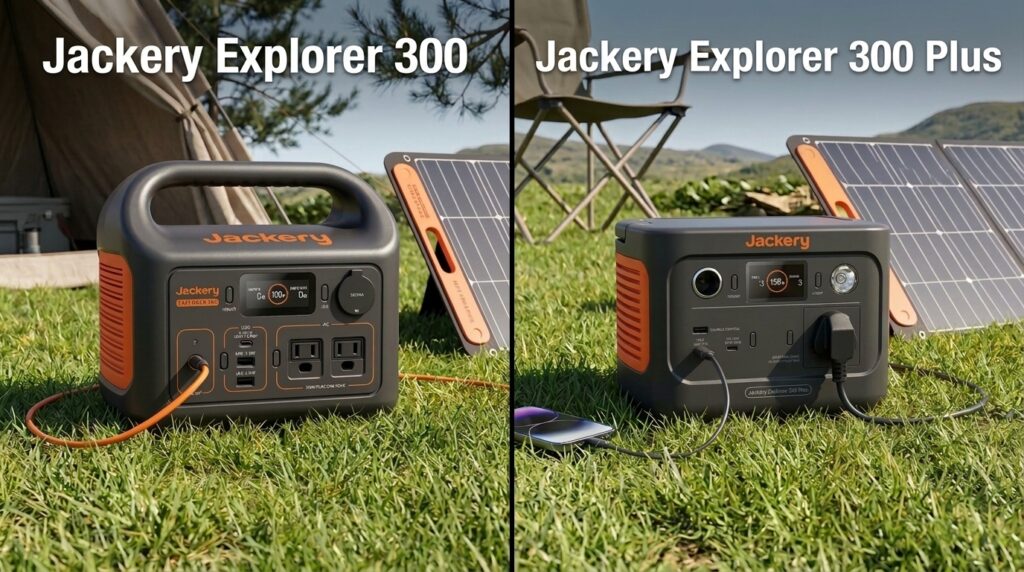
Off-grid recovery speed is vital for the jackery 300 vs 300 plus debate when you are camping for multiple days.
- Battery Chemistry: Both units now utilize premium Lithium Iron Phosphate cells. According to authoritative chemical research (Wikipedia), LiFePO4 is the safest battery technology on the market, highly resistant to thermal runaway. Both models will last for over 3,000 charge cycles, providing a decade of daily use.
- Recharge Speed: The 300 Plus is significantly faster. It can fully recharge from a wall outlet in about 2 hours, and accepts 100W of solar input. The classic 300 takes closer to 4.5 hours to fully recharge via AC or solar.
Final Verdict: Which One Should You Buy?
To conclude the ultimate jackery 300 vs 300 plus showdown, your decision comes down to how much you value modern technology over raw, classic simplicity.
If you want the most modern features, including smartphone app control, a flat-folding handle for easy packing, faster charging speeds, and a reliable EPS mode for home backup, the Jackery Explorer 300 Plus is the superior, future-proof choice for 2026.
However, if you prioritize the absolute lightest physical weight (only 7.1 lbs), prefer a rugged, simple machine with no complicated apps to sync, and want a slightly larger base capacity (292Wh), the Classic Jackery Explorer 300 remains a legendary, dependable workhorse that rarely disappoints.
Are you still deciding between Jackery and other budget brands? See how it stacks up against the competition here: 3 Best Portable Power Stations Under $300 in 2026.
FAQ
Which is better for CPAP in the jackery 300 vs 300 plus matchup?
The 300 Plus is slightly better for home CPAP use because it features the 20ms EPS mode. If the grid fails while you are sleeping, it will automatically switch to battery power. However, for off-grid tent camping, both units will easily power a CPAP (humidifier off) for 2 to 3 nights.
Do both units in the jackery 300 vs 300 plus comparison use LiFePO4 batteries?
Yes. While the classic Jackery 300 originally launched with older lithium-ion cells, Jackery recently updated its internal chemistry to premium LiFePO4 (LFP) cells, matching the safety and longevity of the newer 300 Plus model.
Which is faster to recharge in the jackery 300 vs 300 plus test?
The Jackery 300 Plus is the clear winner for charging speed. It can fully recharge from a standard wall outlet in just 2 hours, whereas the classic Jackery 300 takes over 4 hours to reach a full charge.