
Disclaimer: This article may contain affiliate links. As an Amazon Associate, we earn from qualifying purchases at no extra cost to you.
Knowing how to charge portable power station batteries correctly is the difference between a device that lasts 10 years and one that dies in 2 years.
Most owners just plug it in and forget it. But lithium batteries (whether LFP or NCM) are sensitive. They hate being too full (100%) or too empty (0%) for long periods.
In this maintenance guide, we reveal the “Golden Rules” of charging, storage, and care to keep your backup power ready when you need it.
1. The 3 Ways on How to Charge Portable Power Station Units
Before we talk about health, let’s cover the basics. Most units offer three methods:
- AC Wall Outlet: The fastest method (e.g., EcoFlow charges in 1 hour).
- Car Outlet (12V): Slow but essential for road trips.
- Solar Panels: The greenest way. Want to know how fast? Check our guide on How to Choose Portable Solar Panels.
2. The 80/20 Rule (Daily Use)
If you use your station daily (for van life or work), stop charging it to 100% every time.
- The Sweet Spot: Keep the battery between 20% and 80%.
- Why? Charging the last 20% generates heat and stress on the chemical cells.
- Tip: Many modern apps (like EcoFlow) let you set a “Charge Limit” to 80% automatically.
3. How to Store It Long-Term
This is where most people fail. If you put your device in the closet at 0% or 100%, you are killing it.
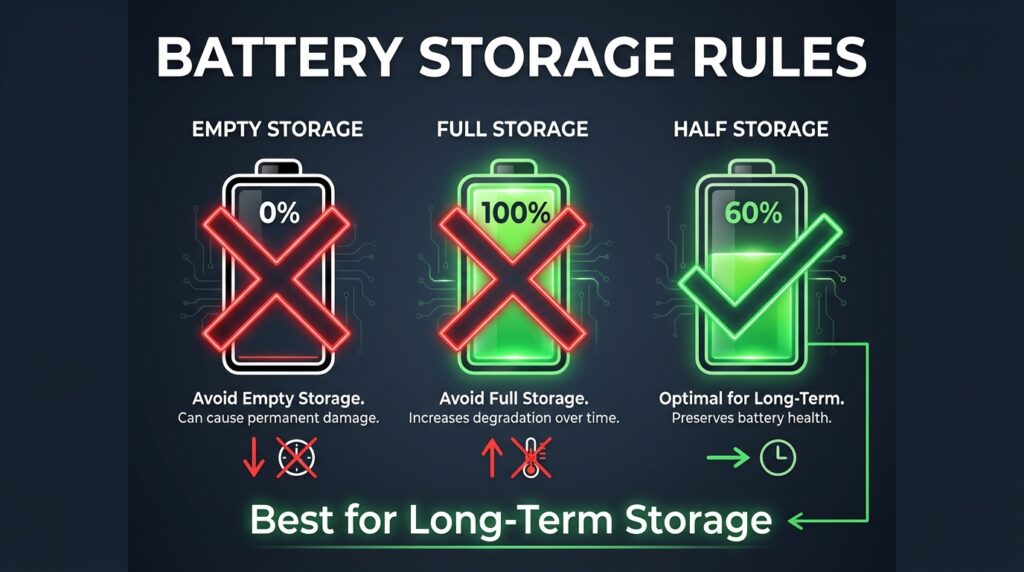
- Ideal Storage Charge: 60% – 70%.
- The “Vampire Drain”: Even when off, batteries lose 1-2% per month.
- Maintenance Schedule: Every 3 months, discharge it to 30% and recharge it to 60%. This keeps the electrons flowing.
Warning: Did you leave it at 0% and now it won’t turn on? Don’t panic yet. Try our revival steps: Why Is My Jackery Not Charging?.
4. Temperature Matters
Batteries are like humans; they hate extreme weather.
- Charging: Never charge below freezing (32°F / 0°C). This causes permanent plating.
- Discharging: You can use it in the cold, but capacity will drop temporarily.
- Storage: Keep it indoors at room temperature (60°F – 80°F).
5. Cleaning and Physical Care
Dust is the enemy of fans.
- Vents: Use compressed air to blow dust out of the cooling vents every 6 months.
- Ports: Keep the USB and AC ports dry and cover them with the rubber flaps when not in use.
6. Bonus Tip: Calibrating the BMS
Does your screen jump from 20% to 0% instantly? This means your Battery Management System (BMS) is out of sync. It doesn’t mean the battery is broken; it just needs calibration.
To fix this, perform a “Calibration Cycle” every 3 to 6 months:
- Fully discharge the unit until it turns off automatically.
- Let it cool down for an hour.
- Recharge it to 100% without interruption.
This resets the digital counter and ensures the percentage you see on the screen is accurate.
Conclusion
Learning how to charge portable power station units properly is simple: Don’t freeze them, don’t starve them (0%), and don’t overfeed them (100% all the time).
If you follow these rules, your LFP battery can easily last for a decade. For more on battery longevity, read our comparison: How Long Does a Portable Power Station Last?.
FAQ
Q: Can I leave it plugged in all the time?
A: When learning **how to charge portable power station** devices safely, only leave them plugged in if they support “Pass-through” mode.
Q: How often should I cycle the battery?
A: If it’s in storage, perform a full cycle (discharge/recharge) every 3 to 6 months to calibrate the screen accuracy.
Q: Is fast charging bad for the battery?
A: Frequent fast charging generates heat, which degrades cells over time. Use “Standard” or “Silent” charging mode when you are not in a rush.