
Disclaimer: This article may contain affiliate links. As an Amazon Associate, we earn from qualifying purchases at no extra cost to you.
🌍 Note for International Readers: The images in this review feature the US (110V) model. However, our “Check Price” links are smartly geo-targeted. When you click, you will be automatically redirected to the correct local Amazon store (UK, CA, AU) showing the 220V/240V version with your correct local wall plugs.
The Anker SOLIX C300 is currently dominating the portable power market in 2026, selling thousands of units every month. Weighing just 8.3 lbs and packing a 288Wh LiFePO4 battery, it is the ultimate lightweight companion for tent camping, remote work, and CPAP machines. But to truly enjoy endless off-grid power, you must pair it with the best solar panels for anker solix c300.
Because the C300 is an ultra-compact device, it has very specific solar input limits. If you buy a massive, oversized solar array, the machine will reject the power, and you will have wasted hundreds of dollars.
To achieve a fast and safe off-grid recharge, you need a lightweight panel that perfectly matches the 100W capacity of the unit. In this 2026 guide, we break down the exact voltage limits, the XT60 adapter rules, and rank the absolute best solar panels for anker solix c300 to help you recharge anywhere in under 4 hours.
1. The Cheat Sheet: SOLIX C300 Solar Limits
Before spending money on the best solar panels for anker solix c300, you must memorize the MPPT charge controller limits built into the machine. Exceeding the Maximum Voltage (Voc) can permanently damage the battery management system.
| Specification | SOLIX C300 Limit | What It Means For You |
| Max Solar Input | 100W | The unit will cap incoming power at 100 Watts safely. |
| Voltage Limit (Voc) | 11V to 28V (CRITICAL) | Do NOT connect large 200W+ panels with high voltages. |
| Input Port Type | XT60 | Third-party panels require an MC4 to XT60 adapter. |
| Charge Time | ~3.5 Hours | Recharges fully in under 4 hours with a perfect 100W panel. |
Want to know everything this tiny beast can do? Read our full hands-on test: Anker SOLIX C300 Review (2026): The Ultimate Camping Battery?
2. Best Overall for Portability: Anker SOLIX PS100
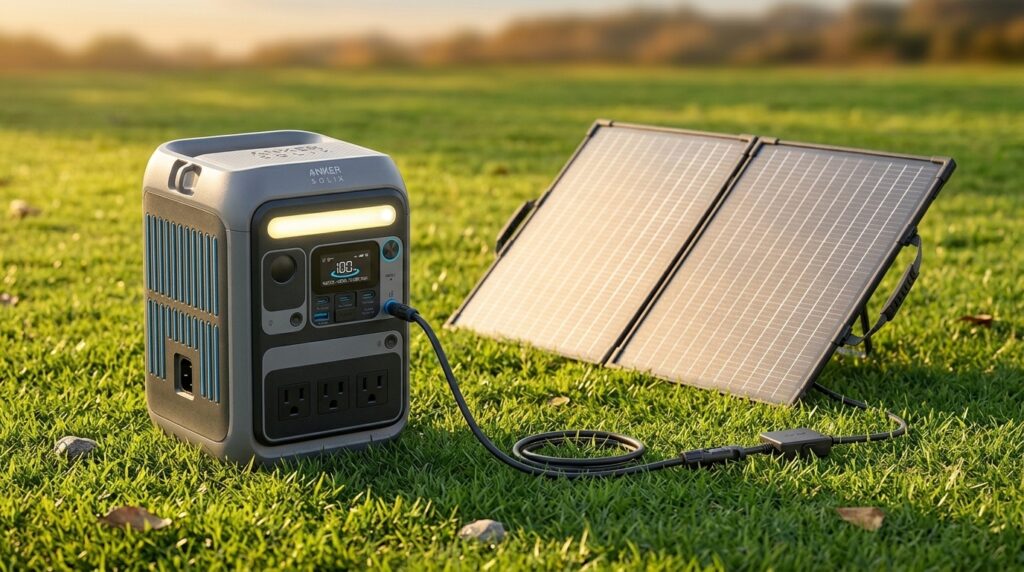
If you want a flawless, plug-and-play experience without dealing with adapter cables, the native Anker SOLIX PS100 Portable Solar Panel is unequivocally the best solar panels for anker solix c300.
- Why it wins: It is engineered specifically for the SOLIX ecosystem. The PS100 provides exactly 100W of power, perfectly matching the C300’s input limit. It features premium monocrystalline cells with an impressive 23% conversion efficiency and an IP67 waterproof rating.
- Ultra-Light Design: The C300 is designed to be highly portable, and the PS100 matches that energy. It folds up extremely thin, making it easy to slide behind an RV seat or carry on a short hike.
- The Setup: It comes with an XT60 cable built right in. You simply unfold the panel, plug it directly into the C300, and you are immediately generating power.
3. Best Budget Alternative: Renogy 100W Portable Panel

If you have already spent your budget on the battery and want the best solar panels for anker solix c300 at a much lower price point, the Renogy 100W Portable Solar Panel is a brilliant third-party alternative.
- Why it wins: Renogy is highly respected in the van-life community for making rugged, efficient panels that cost a fraction of premium brands. You still get 100W of reliable power and built-in kickstands to track the sun.
- The Catch: Renogy uses standard MC4 connectors, not XT60.
- How to Connect It: Because the SOLIX C300 requires an XT60 input, you MUST purchase an MC4 to XT60 Adapter Cable from Amazon. Connect the MC4 cables together, plug the XT60 end into the Anker, and you have an incredible budget setup.
Not sure if 300Wh is enough for your camping trip? See our reality check: What Can a 300W Portable Power Station Run?
4. Can I Use a 200W Panel on the C300? (The Warning)
Many users try to connect the massive 200W panels designed for larger units. When choosing the best solar panels for anker solix c300, you must be careful with over-paneling.
- The Rule: You can use a larger panel, but the Anker SOLIX C300 will only accept 100W. The extra 100W is completely wasted.
- The Danger: The real danger is the Voltage (Voc). The C300 has a strict limit of 28V. Many large 200W or 400W panels produce 40V or more. If you plug a high-voltage panel into the C300, you will fry the internal inverter.
Verdict: Stick to 100W panels. They are cheaper, lighter, and perfectly matched to the unit’s 28V limit.
Final Thoughts
The Anker SOLIX C300 is an incredibly capable machine, but it requires the right solar setup to shine off-grid. Finding the best solar panels for anker solix c300 is about maximizing its 100W input while maintaining its ultra-portable design.
For the most effortless, native plug-and-play experience, the Anker SOLIX PS100 is unmatched. Its built-in XT60 cable and IP67 waterproofing make it the perfect companion. If you are a savvy camper looking to save money, pairing a Renogy 100W Portable Panel with an MC4 to XT60 adapter will give you the exact same charging speed at a fantastic budget price.
Are you still comparing the Anker C300 to other budget models? Read our updated ranking: 3 Best Portable Power Stations Under $300 in 2026 (Tested).
FAQ
Do I need an adapter for the best solar panels for anker solix c300?
It depends on the brand. If you buy the native Anker SOLIX PS100, no adapter is needed. If you buy a third-party panel like Renogy or BLUETTI, you will need to purchase an MC4 to XT60 adapter cable.
Can I mix third-party brands with the best solar panels for anker solix c300?
Because the SOLIX C300 only accepts a maximum of 100W, you should only use one single 100W panel at a time. You cannot wire multiple panels together, so mixing brands is not applicable or recommended for this specific unit.
Why are my best solar panels for anker solix c300 charging slowly?
Solar panels are rated for perfect laboratory conditions. In the real world, factors like cloud cover, heat, and the angle of the sun reduce efficiency. With a 100W panel, you should expect to see an actual input of 75W to 85W on a clear, sunny day.