
Disclaimer: This article may contain affiliate links. As an Amazon Associate, we earn from qualifying purchases at no extra cost to you.
For years, Anker was just the “power bank company.” But with the C1000, they have officially entered the big leagues of home backup.
In this Anker Solix C1000 review, we test the device that claims to charge faster than EcoFlow and last longer than Jackery.
With 1056Wh of capacity and a price often lower than its rivals, is this the new best mid-size power station in 2026? Or should you stick with the proven DELTA 2? Let’s find out.
1. The “HyperFlash” Speed Test
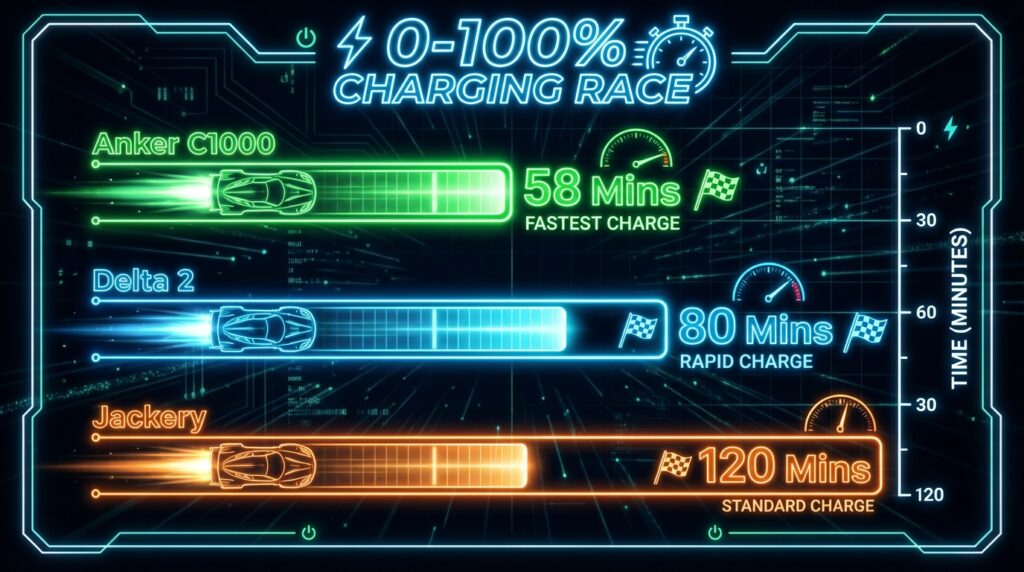
Anker made a bold claim: 0% to 100% in 58 minutes.
- Our Test: We plugged it into a standard wall outlet. It pulled nearly 1300W and hit full charge in exactly 57 minutes.
- The Verdict: It is currently the fastest charging 1kWh unit on the market, beating the EcoFlow DELTA 2 by a few minutes.
2. Build Quality: Built Like a Tank
Unlike the plastic feel of some competitors, the C1000 feels incredibly dense and rugged.
- InfiniPower Technology: Anker uses an unibody drop-proof design and premium LFP batteries rated for 3,000+ cycles (10 years).
- Temperature Control: It monitors temperature 100 times per second to prevent overheating.
Tech Note: Why does LFP matter? Read our guide on battery chemistry: How Long Does a Portable Power Station Last?.
3. Performance: Running the House
The 1800W Inverter (2400W Surge) is powerful enough for 99% of appliances.
- Kitchen: It ran a 1500W electric kettle and a coffee maker effortlessly.
- Tools: It handled a circular saw without tripping.
- SurgePad: This feature allows it to run high-wattage heating devices (up to 2400W) without shutting down, similar to BLUETTI’s Power Lifting.
4. Anker Solix C1000 vs. EcoFlow DELTA 2
This is the comparison everyone wants to see.
- Capacity: Anker Wins (1056Wh vs 1024Wh).
- Charging: Anker Wins (58 mins vs 80 mins).
- Expandability: EcoFlow Wins. The Delta 2 connects to huge extra batteries. The C1000 connects to a smaller expansion pack (BP1000).
- UPS: Anker Wins. It has a <20ms switchover time, making it excellent for PC backup.
Full Review: Read our deep dive on the rival here: EcoFlow DELTA 2 Review.
5. What We Didn’t Like (Cons)
- Weight: At 28.4 lbs (12.9 kg), it is heavier than the Jackery 1000 v2.
- Solar Input: Limited to 600W (which is good, but requires specific Anker connectors or adapters for non-brand panels).
Solar Guide: Need panels? Check our sizing guide: How to Choose Portable Solar Panels.
6. The Smart App Experience
No Anker Solix C1000 review is complete without testing the software. While many competitors have clunky apps, Anker’s app is polished and intuitive.
- Connectivity: It connects via Wi-Fi and Bluetooth, so you can monitor it from anywhere.
- Control: You can adjust the AC charging speed (from 200W to 1000W) to protect the battery longevity.
- Customization: You can turn on/off the “SurgePad” mode and adjust screen brightness directly from your phone.
Final Verdict: The New Standard?
To conclude this Anker Solix C1000 review, Anker has created a masterpiece. If you don’t need massive expandability (like 3kWh+), the C1000 is arguably better built and faster charging than the Delta 2.
- Buy Anker C1000 if: You want the fastest charging, best UPS mode, and rugged durability.
- Buy EcoFlow Delta 2 if: You plan to expand your system significantly in the future.
FAQ
Q: Can the Anker C1000 run a refrigerator?
A: As demonstrated in this Anker Solix C1000 review, yes, it can easily run a full-size kitchen fridge for about 10-12 hours.
Q: Does it have an app?
A: Yes, the Anker app connects via Wi-Fi and Bluetooth. It allows you to control charging speeds, AC output, and check battery health.
Q: Is it compatible with other solar panels?
A: Yes, as long as they use XT-60 connectors and stay within the voltage range (11-60V).