
Disclaimer: This article may contain affiliate links. As an Amazon Associate, we earn from qualifying purchases at no extra cost to you.
🌍 Note for International Readers: The images in this review feature the US (110V) model. However, our “Check Price” links are smartly geo-targeted. When you click, you will be automatically redirected to the correct local Amazon store (UK, CA, AU) showing the 220V/240V version with your correct local wall plugs.
You set up your campsite, angled your solar panel directly at the blazing sun, and plugged it into your power station. But when you look at the screen, the input says “0 Watts.”
Nothing is happening.
If you are frustrated and asking, “why is my portable solar panel not charging?”, you are not alone. This is the #1 issue campers face off-grid. The good news? It is almost never a broken panel.
In this 2026 troubleshooting guide, we will walk you through the 5 most common reasons your solar setup is failing, and the quick fixes to get the juice flowing again.
1. The 10-Second Diagnostic Cheat Sheet
Before we dive deep, check this table to quickly identify your problem.
| What You See | The Likely Culprit | The Quick Fix |
| 0 Watts (Bright Sun) | The “Micro-Shade” Effect | Move the panel out of any small tree shadows. |
| 0 Watts (Clicks loudly) | Voltage Mismatch (Over-voltage) | Ensure panel Voc doesn’t exceed battery limits. |
| Charges at 5W – 10W | Dirty Cells or Bad Angle | Wipe the ETFE surface and tilt it 45 degrees. |
| Screen is Frozen | BMS Software Glitch | Hard reset your portable power station. |
| Cable feels loose | Adapter Mismatch | Check MC4 to XT60 / 8mm adapter pins. |
2. Fix #1: The “Micro-Shade” Effect
If you are wondering why your setup fails when it is sunny outside, look closely at the panel’s surface.
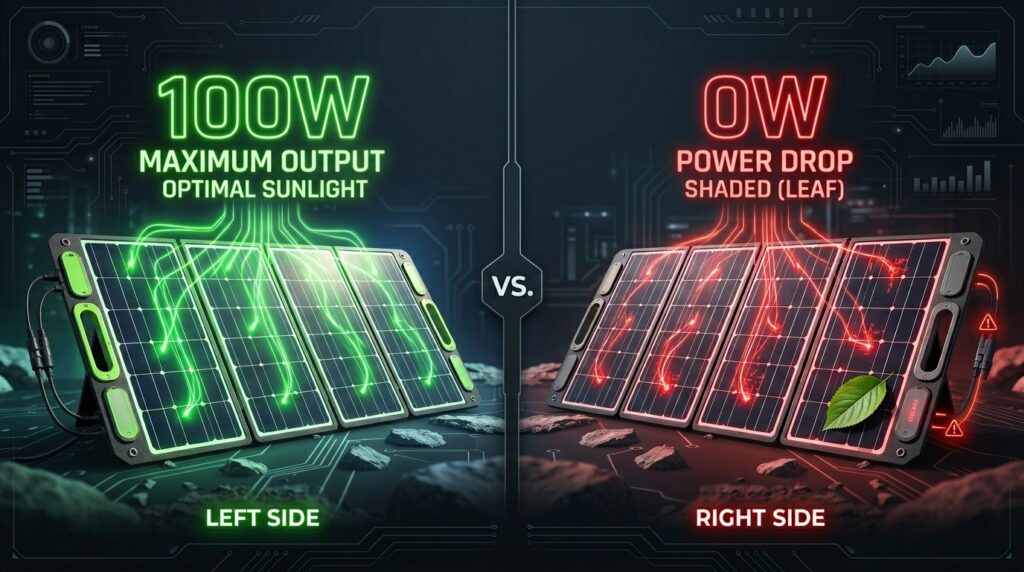
- The Problem: Inside most foldable solar panels, individual solar cells are connected in series. This means that if even 10% of the panel’s surface is covered by a shadow from a tiny tree branch or a leaf, the internal electrical circuit is interrupted. The MPPT charge controller inside your power station then struggles to find the ‘Maximum Power Point’ (MPP), causing the entire panel’s output to drop significantly—sometimes to nearly zero.
- The Fix: Move the panel to a 100% clear area. Ensure no grass, straps, or cables are resting on the solar cells.
If you are still wondering why is my portable solar panel not charging, always check for these tiny shadows first before assuming the hardware is broken.
3. Fix #2: The Over-Voltage Lockout (BMS)
Your portable power station has a built-in computer called a BMS (Battery Management System). If it senses danger, it locks the input port.
- The Mistake: Plugging a massive 400W rigid solar panel into a small battery like an EcoFlow RIVER 2.
- The Science: Small batteries have a strict Voltage limit (e.g., 30V Max). Large panels often output 40V+. If the voltage is too high, the BMS will block the charge to prevent a fire.
- The Fix: Check the “Voc” (Open Circuit Voltage) sticker on the back of your panel. Ensure it is lower than your power station’s max input limit.
Sizing Help: Are you using the wrong panel for your battery? Read our guide: How to Choose Portable Solar Panels.
4. Fix #3: Cable & Adapter Glitches
Another common reason why is my portable solar panel not charging relates to the physical cables. Unlike wall chargers, solar cables endure dirt, rain, and pulling.
- The Culprit: The most common failure point is the adapter. If you are using a third-party “MC4 to XT60” or “MC4 to DC7909 (8mm)” cable, the pins inside can bend or corrode.
- The Fix: Unplug all cables. Blow into the connectors to remove dust. Reconnect them firmly until you hear a “Click.” If it still fails, the $15 adapter cable might be dead and needs replacing.
EcoFlow Owners: Need the exact right cable setup? See our specific guide: Best Solar Panel for EcoFlow RIVER 2.
5. Fix #4: Reset the Power Station
Sometimes the solar panel is perfectly fine, but the power station’s computer is frozen.
- The Symptom: You plug the panel in, but the screen stays blank or the input wattage freezes at an old number.
- The Fix: Unplug the solar panel. Press and hold the main power button on your battery for 10 to 15 seconds to perform a hard reset. Turn it back on, then plug the panel back in.
Jackery Owners: If your unit is still completely dead, read our dedicated breakdown: Why Is My Jackery Not Charging? (7 Fixes).
6. Fix #5: Heat Degradation (The Silent Killer)
Solar panels love light, but they hate extreme heat.
- The Problem: If it is 100°F (38°C) outside, the dark surface of your solar panel can reach 150°F+. According to the Department of Energy (DOE), high temperatures can significantly reduce the efficiency and power output of your solar cells.
- The Fix: You cannot change the weather, but you can cool the panel. Prop it up off the hot ground using its kickstands to allow airflow underneath. Never lay it flat on hot asphalt.
Final Thoughts
So, why is my portable solar panel not charging? In 90% of cases, it is a simple shadow covering a corner of the panel, or a bent pin in your adapter cable. Keep your panels clean, angle them directly at the sun, and always ensure the voltage matches your battery.
If your panel is physically damaged or deeply degraded, it might be time to upgrade. Check out our 2026 test results for the most durable replacements: 6 Best Portable Solar Panels for Camping.
FAQ
Q: Why is my portable solar panel not charging even when the sun is out?
A: It is usually due to a micro-shade covering a solar cell, an overheated panel, or a bent pin inside your adapter cable. Always check your connections and ensure 100% of the panel is in direct sunlight.
Q: Do I need to buy a specific brand of solar panel for my power station?
A: No, you do not have to buy the exact same brand. As long as the solar panel has the correct connectors (like MC4, XT60, or DC7909) and the panel’s voltage (Voc) stays below your power station’s maximum input limit, you can mix and match brands to save money. However, buying the same brand often guarantees immediate compatibility without needing extra adapter cables.
Q: Can portable solar panels go bad?
A: Yes. Foldable fabric panels (PET) degrade over time due to UV exposure and constant folding. Premium panels coated in ETFE last much longer (up to 10 years).
Q: Can I use a multimeter to check if my solar panel is working?
A: Yes. If you have a multimeter, set it to DC Voltage. Measure the pins on the back of your solar panel. A 100W panel should output between 18V and 22V in direct sun. If the reading is 0V, the panel is likely dead, or a connection wire inside the junction box has snapped.