
Disclaimer: This article may contain affiliate links. As an Amazon Associate, we earn from qualifying purchases at no extra cost to you.
🌍 Note for International Readers: The images in this review feature the US (110V) model. However, our “Check Price” links are smartly geo-targeted. When you click, you will be automatically redirected to the correct local Amazon store (UK, CA, AU) showing the 220V/240V version with your correct local wall plugs.
When a severe winter storm or a summer grid failure knocks out your power, the clock starts ticking. Within 4 hours, the food in your kitchen fridge begins to spoil. In these emergencies, many homeowners ask a critical question: can a solar generator run a refrigerator reliably during a blackout?
The short answer is yes, absolutely. However, the long answer is that you cannot just plug a full-size kitchen appliance into a cheap camping battery. If the unit is too small, the compressor will instantly trip the inverter, leaving you in the dark with spoiled food.
To make a solar generator run a refrigerator safely for days, you need serious surge capacity and deep battery storage.
In this 2026 technical guide, we will reveal the exact math behind fridge power consumption, the minimum battery size you need, and rank the absolute best models on the market today.
1. The Math: Having a Solar Generator Run a Refrigerator
Before you buy any backup battery, you must understand the difference between “Running Watts” and “Surge Watts.” According to the official ENERGY STAR standards, modern certified refrigerators are designed to be highly energy-efficient, yet they still require a massive initial surge of power. Managing this starting surge is the real secret to successfully having a solar generator run a refrigerator
- Running Watts (Continuous): A modern full-size kitchen refrigerator typically uses between 300W to 800W while the compressor is actively cooling.
- Surge Watts (Starting): When the fridge’s compressor first kicks on, it requires a massive, split-second spike of energy. This surge can be up to 3 times higher than the running watts (often hitting 1200W to 2000W).
The Golden Rule: Your chosen power station MUST have a “Surge Output” higher than your fridge’s starting wattage, or it will shut down immediately.
2. What Size Do I Need to Make a Solar Generator Run a Refrigerator?
If you want a safe, reliable setup that won’t fail during a crisis, you need to look at the 2kWh (2000-watt-hour) category.
Smaller 500Wh or 1000Wh units might start a modern fridge, but they will drain completely in just 3 to 4 hours. A 2000Wh unit provides the massive surge power needed to start the compressor safely, and it stores enough energy to make a solar generator run a refrigerator for 14 to 24 hours without needing a solar recharge.
Need more details on what these massive batteries can do? Read our guide: What Can a 2000W Portable Power Station Run?
3. Best Models: Which Solar Generator Run a Refrigerator Best?
Now that you know the math, here are the two safest and most powerful LiFePO4 models capable of running your kitchen fridge for days in 2026.
Top Pick: EcoFlow DELTA 2 Max
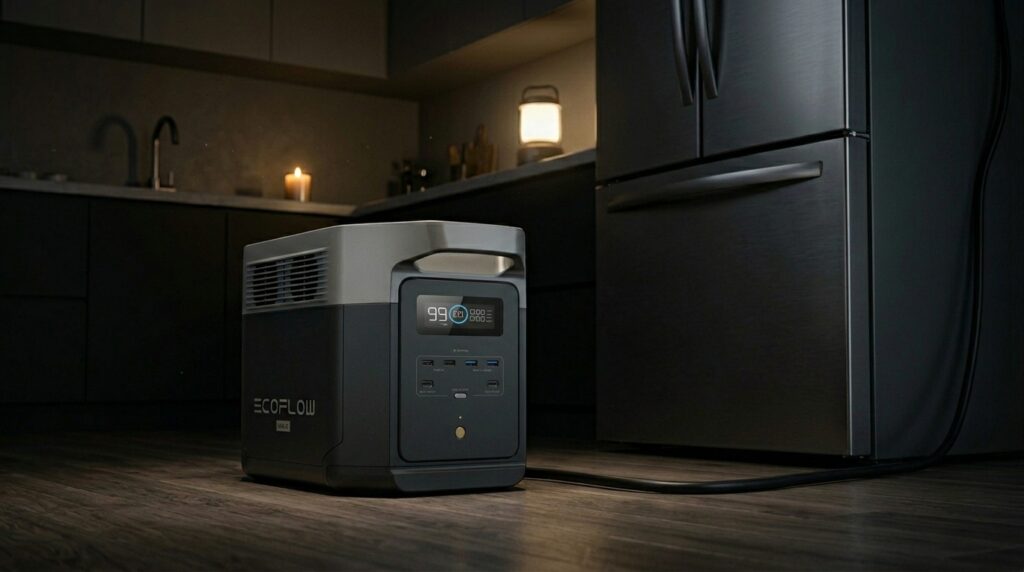
When searching for the ultimate home backup, the EcoFlow DELTA 2 Max is our number one recommendation to help a solar generator run a refrigerator smoothly.
- Why it wins: It packs a 2048Wh battery and features a continuous output of 2400W (with a massive 4800W surge). It will start any fridge compressor effortlessly.
- The X-Boost Feature: Even with the fridge running, you can still plug in your coffee maker or microwave, and the unit will intelligently manage the power without crashing.
- Runtime: It can run a standard 120W fridge for up to 14 hours. If you hook up its solar panels during the day, it can power your food storage indefinitely.
Read our full, hands-on test here: EcoFlow DELTA 2 Max Review (2026).
💡 Pro Tip: Double Your Runtime for Multi-Day Outages
If you live in an area prone to severe hurricanes or multi-day blackouts, the base 14-hour runtime might not be enough. EcoFlow allows you to plug in the DELTA 2 Max Extra Battery, instantly doubling your capacity to 4096Wh. This upgrade allows your solar generator run a refrigerator for up to 28-30 hours straight without a single drop of sunlight!
Best for Extended Blackouts: Jackery Explorer 2000 Plus
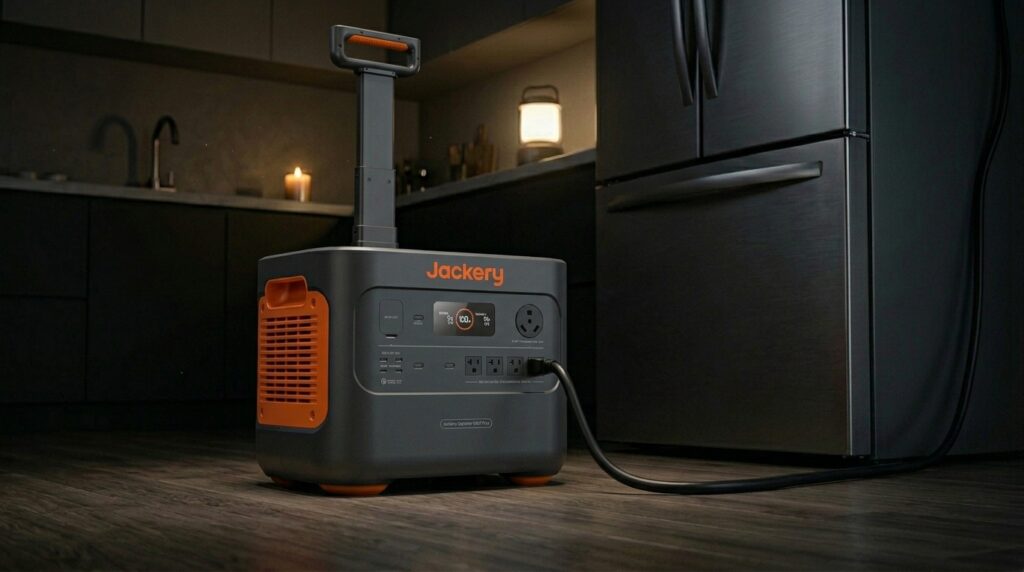
If you live in an area prone to multi-day hurricanes or grid failures, the Jackery Explorer 2000 Plus is an expandable beast built for extreme survival.
- Why it wins: It offers a staggering 3000W of running power and a 6000W surge. But its true strength is expandability. You can add extra battery packs to this unit, scaling it up to an insane 24kWh.
- The Design: Despite its heavy weight, it features built-in wheels and a luggage handle, making it easy to roll right into your kitchen next to the fridge.
Torn between these two massive units? See our direct showdown: EcoFlow DELTA 2 Max vs Jackery 2000 Plus: The Ultimate 2kWh Showdown.
Final Thoughts
Losing hundreds of dollars worth of groceries during a blackout is entirely preventable. It is highly practical to have a solar generator run a refrigerator, but you must invest in the right size.
Avoid cheap, small camping batteries. For peace of mind, the best models are 2000W units like the EcoFlow DELTA 2 Max or the Jackery 2000 Plus. They provide the high surge capacity needed to start the compressor safely and the battery depth to keep your food cold all night long.
Want to see other heavy-duty options? Check out our ranking: 4 Best 2000W Portable Power Stations in 2026.
FAQ
How long will a solar generator run a refrigerator?
A fully charged 2000Wh unit will power a standard, energy-efficient kitchen refrigerator for about 14 to 20 hours. Because a fridge compressor cycles on and off (it doesn’t run constantly), the battery lasts much longer than expected.
Can I leave the solar panels connected while the fridge is running?
Yes! This is called “pass-through charging.” If you leave your unit connected to solar panels outside during the day, the sun will power the fridge and recharge the battery simultaneously, making your solar generator run a refrigerator off-grid for days.
Will a 1000W power station run a refrigerator?
It might start a smaller, modern fridge, but a 1000Wh battery will likely be completely drained in under 6 hours. It is highly recommended to use a 2000W unit for reliable overnight home backup.
Can you use an extension cord with these units? If unit is outside under covered porch, can an extension cord be used to plug in fridge?
Hi Jae, great question!
Yes, you can absolutely use an extension cord to run your fridge from a power station on the porch, but you have to be very careful about the type of cord you use.
Refrigerators require a massive surge of power to start the compressor. If you use a standard, thin indoor extension cord, it will cause a “voltage drop” over the distance. This means the fridge won’t get enough power to start, and the power station’s inverter might trip.
Here is the golden rule for your setup:
Use a Heavy-Duty Cord: You MUST use a thick, heavy-duty extension cord rated at 12-gauge (12 AWG) or 10-gauge (10 AWG).
Keep it Short: Try to keep the cord as short as possible (ideally under 25 to 50 feet). The longer the cord, the more power you lose.
Protect the Unit: Even on a covered porch, ensure the power station is protected from blowing rain and extreme humidity, as these units are not waterproof.
A high-quality 12-gauge appliance extension cord will easily handle the surge and keep your food cold without any issues. Stay safe!
Pingback: BLUETTI FridgePower Review (2026): Best Refrigerator Backup?