
Disclaimer: This article may contain affiliate links. As an Amazon Associate, we earn from qualifying purchases at no extra cost to you.
Buying a backup battery can feel like gambling. Buy one that is too small, and your food spoils when the fridge dies. Buy one that is too big, and you waste $1,000 on capacity you will never use.
The most common question we receive from our readers is simply: “What size portable power station do I need?”
If you are asking yourself, “What size portable power station do I need?”, you are not alone. Buying the wrong size can mean spoiled food or wasted money. In this 2026 sizing guide, we help you calculate the exact capacity.
1. The Golden Rule: Watts vs. Watt-Hours
Before you pull out your credit card, you must understand the difference between the two numbers printed on every box. Confusing them is the #1 mistake buyers make.
- Watts (W) = Strength: This determines what devices you can turn on. (e.g., A microwave needs 1500W to start).
- Watt-Hours (Wh) = Stamina: This determines how long they will run. (e.g., A 500Wh battery runs a 100W TV for about 4-5 hours).
The “Back-of-Napkin” Formula:(Device Watts) x (Hours you need it) = Target Wh Capacity.
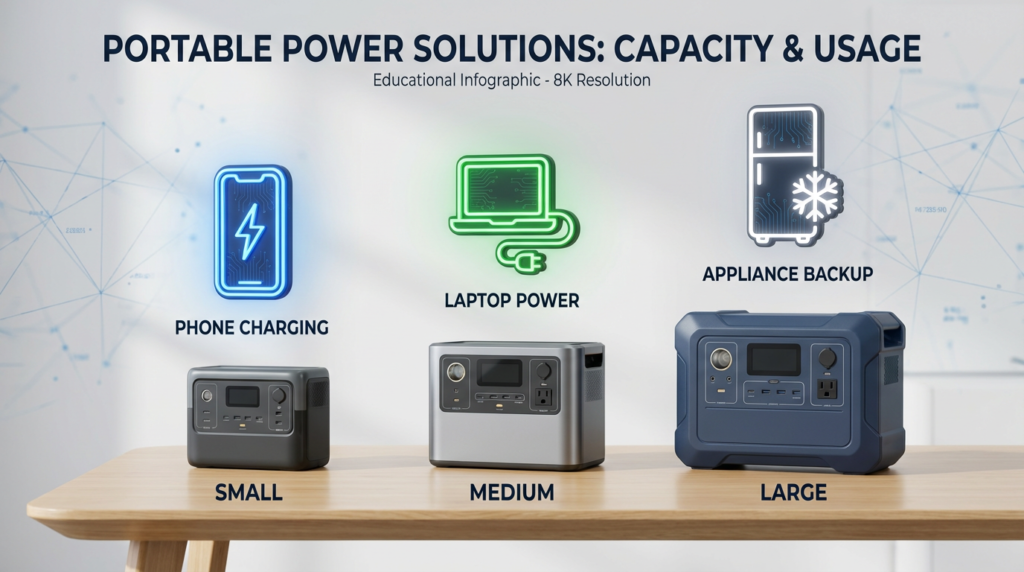
2. Scenario A: The Weekend Camper (300Wh – 500Wh)
If your goal is to keep phones charged, run a drone, and light up a tent, you do not need a heavy beast. You need portability.
- Who is this for? Hikers, Solo Campers, Van Lifers.
- What it runs: Smartphone (25 charges), Laptop (3 charges), CPAP (1 night without heated humidifier).
- Recommended Gear: The Jackery 300 Plus is the standout here. It features a compact folding handle and fits easily in a backpack.
Budget Tip: You don’t need to spend a fortune for this size. Check our curated list of the Best Portable Power Stations Under $300.
3. Scenario B: The Blackout Survivor (1000Wh – 1500Wh)
This is the “Sweet Spot” for most homeowners. You want enough power to handle a coffee maker or a router for days, but you still want to be able to carry it.
- Who is this for? Families, Remote Workers, CPAP users (multi-night).
- The 1000W Rule: A frequent question is “What exactly can a 1000W unit run?” The answer is: almost 90% of your household appliances, excluding heaters and ACs.
- Recommended Gear: The Jackery 1000 v2 is the king of this category, updated in 2026 with a rugged build and faster charging.
Deep Dive: Want to see the full list of devices a 1k unit handles? Read our breakdown: What Can a 1000Wh Portable Power Station Run?.
4. Scenario C: The Heavy Lifter (2000Wh+)
This is where we talk about refrigerators. If you want to keep your food from spoiling during a 24-hour blackout, you need serious capacity.
- The Fridge Challenge: A standard kitchen fridge needs a massive “surge” of power (1200W+) just to start the compressor. Small units will trip and shut down.
- The Solution: You need a unit like the EcoFlow DELTA 2 (expandable) or larger, which offers high surge capability.
Critical Guide: Refrigerators are tricky. Before you buy, read our technical analysis: Can a Solar Generator Run a Refrigerator?.
5. Why You Should Oversize by 20%
When calculating what size portable power station do I need, never aim for the exact number. Always add a 20% buffer.
- Efficiency Loss: No battery is 100% efficient. The inverter burns some energy converting DC to AC. A 1000Wh battery usually gives you about 850Wh of usable power.
- Safety & Lifespan: As we explained in our Indoor Safety Guide, constantly draining a battery to 0% generates excess heat and shortens its life. Keeping a buffer keeps your device safe.
Final Verdict: What Size Portable Power Station Do I Need?
To summarize, here is your quick cheat sheet for 2026:
- Light Use (Phones/Lights): Go for 300Wh.
- Home Backup (TV/Router/CPAP): Go for 1000Wh.
- Heavy Duty (Fridge/Sump Pump): Go for 2000Wh+.
Choose the size that fits your worst-case scenario, not just your average day.
FAQ
Q: Will a 500W power station run a TV?
A: Yes, absolutely. Most modern LED TVs consume between 60W and 100W. A 500Wh station can run a TV for approximately 4 to 5 hours comfortably.
Q: How do I find the wattage of my appliance?
A: Look for the sticker on the back or bottom of the device. If it only lists Volts (V) and Amps (A), multiply them: Volts x Amps = Watts.
Q: Can I expand the size later?
A: Only specific models allow this. For example, the EcoFlow DELTA 2 supports extra batteries to double its capacity, while most smaller units do not.
Q: Is there a simple rule to know what size portable power station do I need?
A: Yes, the simplest rule is: Determine your device’s wattage and multiply it by the hours you want it to run. This gives you the Wh capacity.