
Disclaimer: This article contains affiliate links. If you make a purchase through these links, we may earn a commission at no extra cost to you.
Many campers and homeowners ask: what can a 1000Wh power station run during a blackout or trip?
When shopping for a portable power station, the numbers can be confusing. You see terms like “1000Wh,” “Watts,” and “Amps,” but what does that actually mean for your camping trip or power outage?
Most people just want to know: “Will this keep my beer cold?” or “Will it keep my CPAP machine running all night?”
The 1000Wh (Watt-hour) category is the “Goldilocks” size of the portable power industry. It is not too heavy to carry, yet powerful enough to run essential appliances for hours (or even days). It is the sweet spot for campers, RV owners, and homeowners preparing for emergencies.
In this guide, we will break down the math simply and give you real-world examples of exactly what a 1000Wh power station—like the Jackery Explorer 1000 v2 or EcoFlow DELTA 2—can actually run.
The “Magic” Formula: How to Calculate Runtime
Before we list the devices, you need to understand one crucial rule: You never get 100% of the battery’s capacity.
Why? Because the “Inverter” inside the station (which converts battery power to wall-outlet power) consumes energy to work. Generally, you should expect about 85% efficiency.
Here is the formula to calculate runtime:
Working Time = (Battery Capacity × 0.85) / Device Wattage
So, for a 1000Wh power station:
- Usable Capacity: approx. 850Wh.
- If you run a 100W TV: 850 / 100 = 8.5 Hours.
Now, let’s look at the real-life scenarios.
Scenario 1: Camping & Outdoor Living


For campers, a 1000Wh unit is a game-changer. It allows you to go “off-grid” for a weekend without sacrificing comfort.
Before packing for your trip, it is essential to calculate what can a 1000Wh power station run to ensure you have enough energy for all your devices.
| Appliance | Avg. Wattage | Estimated Runtime / Charges |
| Smartphone | 10W | 80+ Charges |
| Laptop | 60W | 12+ Charges |
| Drone (DJI) | 40W | 18+ Charges |
| Mini Fridge (12V) | 60W | 14 – 18 Hours* |
| CPAP Machine | 40W | 2 – 3 Nights (without humidifier) |
| LED Camp Light | 5W | 150+ Hours |
*Note on Mini Fridges: A fridge cycles on and off. It doesn’t run 100% of the time. If the weather is cool, a 1000Wh station could easily run a 12V fridge for 24+ hours.
The CPAP User Advantage
If you use a CPAP machine for sleep apnea, a 1000Wh station is arguably the best investment you can make. It guarantees you roughly 3 nights of sleep on a single charge (assuming you turn off the heated humidifier).
Scenario 2: Home Emergency Backup
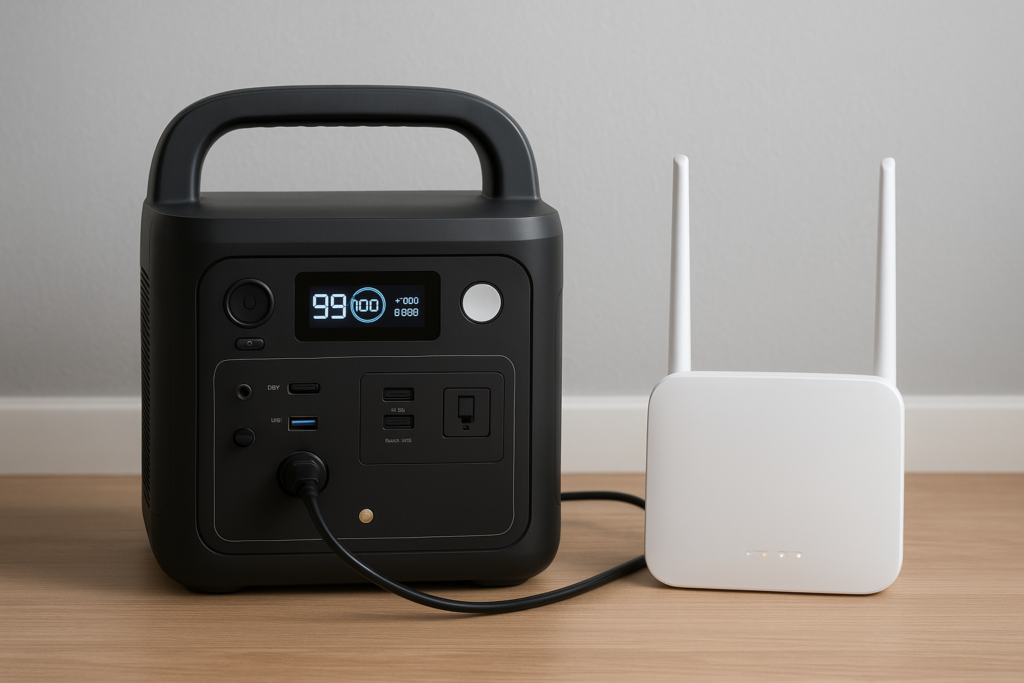
When the grid goes down due to a storm, a 1000Wh station won’t power your whole house, but it will keep the “Survival Essentials” running.
During a blackout, knowing exactly what can a 1000Wh power station run can help you prioritize essential appliances like your router and fridge.
| Appliance | Avg. Wattage | Estimated Runtime |
| Wi-Fi Router | 10W | 80+ Hours (Crucial for communication) |
| Television (50″) | 100W | 8 Hours |
| Full-Size Fridge | 150W (Avg) | 5 – 7 Hours |
| Coffee Maker | 1000W | 45 Minutes (Enough for 8-10 pots!) |
| Sump Pump | 800W | 1 Hour (Continuous pumping) |
| Microwave | 1000W | 45 Minutes (Plenty for heating meals) |
Can it run a large Refrigerator?
Yes, but for a limited time. A full-size kitchen fridge consumes a lot of power to start the compressor (surge power). Once running, it averages about 150W. A 1000Wh station can keep your food safe for about 5 to 7 hours. If you cycle it (run it for 1 hour, off for 2 hours), you could stretch it through a lengthy blackout.
What a 1000Wh Station CANNOT Run
It is important to manage expectations. A 1000Wh battery usually comes with a 1000W to 1500W inverter. This means it cannot handle high-demand appliances that require continuous massive heat or cooling.
Avoid plugging in these devices:
- ❌ Central Air Conditioning (Requires 3500W+)
- ❌ Electric Water Heater (Requires 4000W+)
- ❌ Electric Clothes Dryer
- ❌ Space Heaters (Running on high mode for long periods)
Top Rated 1000Wh Power Stations in 2025
If you are convinced that 1000Wh is the right size for you, there are two market leaders that dominate this category.
1. Jackery Explorer 1000 v2
The updated version of the classic. It now features a long-lasting LiFePO4 battery (10-year lifespan) and a compact, rugged design. It is perfect for campers who value durability and portability.
2. EcoFlow DELTA 2
The tech-lover’s choice. It charges incredibly fast (0-80% in 50 minutes) and has a slightly higher output (1800W), allowing it to run stronger appliances like a toaster or hair dryer more easily.
Want to see a full comparison? Check out our detailed guide: 5 Best Portable Power Stations of 2025: Top Picks for Camping & Home Backup .
Conclusion: What can a 1000Wh power station run effectively?
Is 1000Wh enough? For 90% of people, the answer is Yes.
It strikes the perfect balance between portability and power. It is enough to keep your phones charged, your lights on, your beer cold, and your work laptop running for a weekend trip.
If you need to run a whole house, you might need to look at larger 2000Wh+ units. But for camping and basic home backup, the 1000Wh class is the king of versatility.
Frequently Asked Questions
Q: Exactly what can a 1000Wh power station run simultaneously?
A: You can run multiple devices as long as their total wattage doesn’t exceed the inverter’s limit (usually 1000W-1500W). For example, you can run a mini-fridge, a fan, and charge your phone all at once.
Q: Is 1000Wh enough for a house?
A: It depends on your needs. If you are asking what can a 1000Wh power station run in a whole house, the answer is “essential devices only” (like Wi-Fi, lights, and fridge), not heavy appliances like AC or heaters.