
Disclaimer: This article may contain affiliate links. As an Amazon Associate, we earn from qualifying purchases at no extra cost to you.
If you are a hiker or solo camper, this Jackery Explorer 300 Plus review is exactly what you need. The original Jackery 300 was a legend, but it had an old battery. The new “Plus” version changes everything.
It finally brings LiFePO4 (LFP) technology to the smallest form factor. It fits in a backpack, weighs almost nothing, and promises 10 years of life.
But with faster rivals like EcoFlow, is Jackery still the king of portability? In this 2026 test, we find out.
1. Design & Portability: The “Backpack” Battery
The biggest selling point of this unit is its size. It is incredibly compact.
- Weight: Only 8.27 lbs (3.75 kg).
- Handle: Foldable (unlike the old fixed handle), making it easy to stack.
- Build: Classic rugged Jackery orange/grey, feels solid enough to take a drop.
2. The Major Upgrade: LFP Battery
This is why you buy the “Plus” version.
- Old Jackery 300: Lithium-ion (500 cycles).
- New 300 Plus: LiFePO4 (3000+ cycles).
- Verdict: This unit is an investment. It will last for over a decade of daily use without losing significant capacity.
Why LFP? Learn why this chemistry is safer and longer-lasting in our guide: How Long Does a Portable Power Station Last?.
3. What Can It Power? (The Reality)
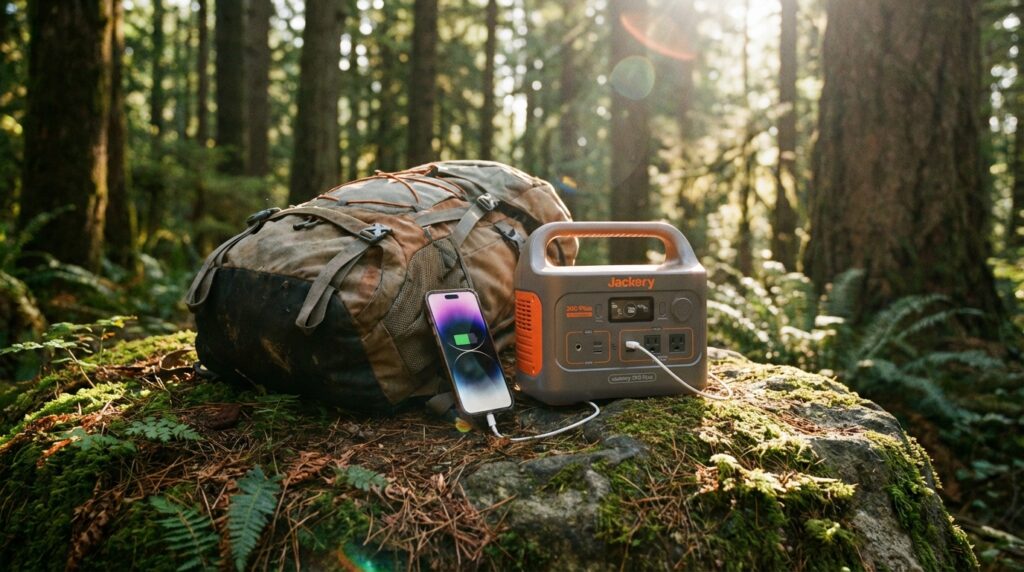
With a 288Wh capacity and 300W inverter, this is not for kitchen appliances. It is for “Digital Survival.”
![Jackery Explorer 300 Plus size comparison fitting in a backpack]
(Internal Image Here)
- ✅ Perfect For: Charging phones (30x), Laptops (3-4x), Cameras, Drones.
- ✅ CPAP Users: It can run a CPAP for 1-2 nights (if humidity is OFF and you use a DC cable).
- ❌ Avoid: Heaters, Blenders, Hair Dryers.
CPAP Guide: Need more sleep time? See how to optimize your setup here: The Ultimate CPAP Camping Battery Guide.
4. Jackery 300 Plus vs. EcoFlow RIVER 2
This is the main battle. We compared them side-by-side.
- Charging Speed: EcoFlow Wins. (60 mins vs Jackery’s 2 hours).
- Portability: Jackery Wins. It feels denser and easier to pack.
- Solar: Jackery Wins. The “Book-Sized” 40W panels are much easier to carry than rigid panels.
Full Battle: Read the detailed comparison here: Jackery 300 Plus vs. EcoFlow RIVER 2.
5. The Cons (Honest Take)
No Jackery Explorer 300 Plus review is fair without mentioning the flaws:
- Charging Speed: It takes about 2 hours to charge via wall outlet. This is slow compared to EcoFlow’s 1 hour.
- App: The app connects via Wi-Fi/Bluetooth but is basic compared to competitors.
- Price: It is often slightly more expensive than the River 2 or Bluetti EB3A.
6. Jackery 300 vs. 300 Plus: Is the Upgrade Worth It?
Many readers ask if they should upgrade from the old model. In this Jackery Explorer 300 Plus review, the answer is a definite “Yes.”
- Battery: The old model used NCM (500 cycles), while the Plus uses LFP (3000+ cycles).
- App: The Plus version adds Wi-Fi/Bluetooth app control, which the old version lacked.
- Weight: The Plus is slightly lighter and smaller.
Final Verdict: Who Should Buy It?
The Jackery Explorer 300 Plus is the best choice for hikers and backpackers who prioritize size and durability over charging speed. It is a “grab-and-go” tank.
- Buy Jackery if you need the smallest LFP footprint.
- Buy EcoFlow if you need 1-hour fast charging.
FAQ
Q: Did your Jackery Explorer 300 Plus review test running a TV?
A: Yes, a small 32-inch LED TV (40W) can run for about 5-6 hours.
Q: Does it come with solar panels?
A: You can buy it as a “Solar Generator” kit which includes the iPad-sized 40W mini panels.
Q: Is it waterproof?
A: No. While rugged, it is not water-resistant. Keep it inside the tent.