
Disclaimer: This article may contain affiliate links. As an Amazon Associate, we earn from qualifying purchases at no extra cost to you.
Finding the best portable solar panels for camping can mean the difference between a great off-grid trip and a ruined weekend with dead batteries. With so many brands claiming high efficiency, it is hard to separate marketing hype from reality.
In this 2026 guide, we test and rank the top 5 foldable and rigid solar panels. We look at waterproof ratings, charging speed, and durability to help you build the ultimate off-grid setup.
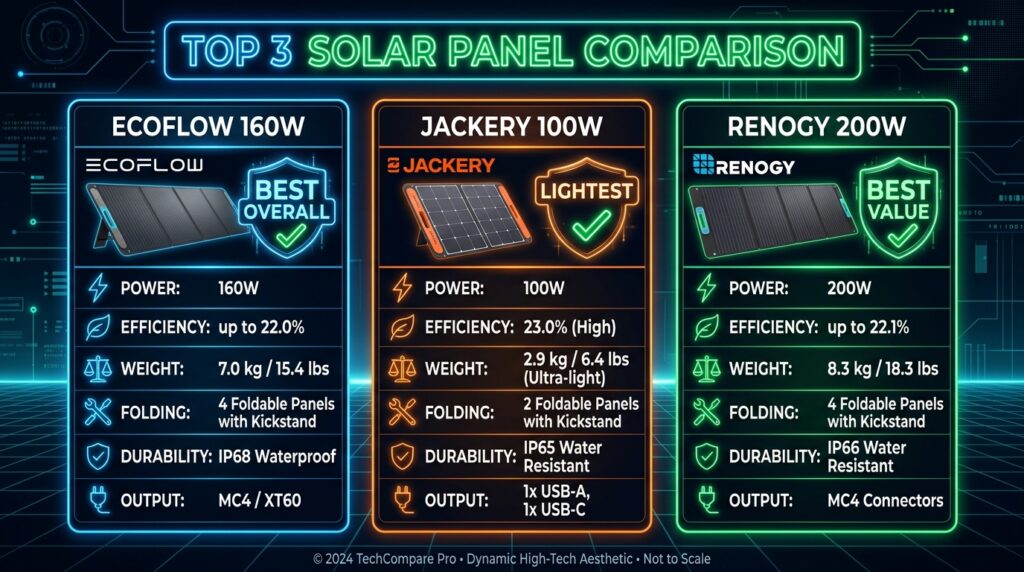
1. Best Overall: EcoFlow 160W Portable Solar Panel
When looking for the best portable solar panels for camping, the EcoFlow 160W is our top overall pick for balancing power and ruggedness.
- Why it wins: It features an IP68 waterproof rating, meaning it can survive heavy rain without frying the circuits. The 160W output is the sweet spot for quickly charging mid-size batteries.
- Efficiency: High conversion rate (up to 22%).
- Best Paired With: The EcoFlow RIVER 2.
2. Best for Portability: Jackery SolarSaga 100W
For hikers and weekend campers, weight and ease of use are everything.
- Why it wins: It folds like a book, has built-in magnetic kickstands, and sets up in literally 10 seconds. It also has USB ports built directly into the panel.
- The Catch: It is only IP65 rated, so you must bring it inside if it rains.
- Deep Dive: Read our full head-to-head comparison: Jackery SolarSaga 100W vs EcoFlow 110W.
3. Best Value for Money: Renogy 200W Eclipse Suitcase
If you need massive power for an RV or long trip but have a strict budget, Renogy is the answer.
- Why it wins: You get a massive 200W of power for almost half the price of premium brands. It comes with a heavy-duty protective case and a built-in charge controller.
- Best Paired With: Large 1kWh batteries like the BLUETTI AC180.
4. Best for Cloudy Days: BLUETTI PV200
Solar panels hate shade, but the BLUETTI PV200 handles it better than most of the competition.
Why it wins: The solar cells are wired in parallel. This means if one section of the panel is shaded by a tree branch, the rest of the panel continues to produce power efficiently.
Technical Spec Check: It is important to note the weight before buying. While their smaller PV120 weighs 12.5 lbs, the PV200 weighs 16.1 lbs (7.3 kg). It is slightly heavier than some rivals, but the extra 200W output is crucial for overcoming overcast skies.
5. Best for Glamping & RVs: EcoFlow 220W Bifacial
This is a high-tech solution for serious boondockers who need maximum output in a small footprint.
- Why it wins: It is a “bifacial” panel, meaning it captures direct sunlight from the front AND ambient light reflecting off the ground from the back, boosting total output by up to 25%.
Sizing Guide: Not sure how many watts you actually need? Don’t guess. Use our detailed calculator: How to Choose Portable Solar Panels.
How to Test Your Solar Panel
Before heading into the wild, you should always verify your panel’s output using a multimeter or a trusted power station screen. According to the Department of Energy (DOE), external factors like temperature, shading, and sun angle drastically affect real-world output. Do not expect 100W from a 100W panel; 75W is normal.
- Troubleshooting: If your battery still won’t charge despite good sunlight, the issue might be the battery’s BMS, not the panel. See our repair guide: Why Is My Jackery Not Charging?.
Final Verdict
Choosing the best portable solar panels for camping comes down to your environment. Buy the EcoFlow 160W for rugged, wet conditions, or the Jackery SolarSaga 100W for lightweight, sunny weekend trips.
FAQ
Q: Can I leave the **best portable solar panels for camping** out in the rain?
A: Only if they have an IP68 rating (like the EcoFlow panels). Most foldable fabric panels (like Jackery) are only IP65 and will suffer permanent damage in heavy rain.
Q: Do portable solar panels work through windows?
A: Technically yes, but very poorly. Standard window glass reflects or blocks a significant amount of UV and visible light, reducing the panel’s power output by 50% or more.