
Disclaimer: This article may contain affiliate links. As an Amazon Associate, we earn from qualifying purchases at no extra cost to you.
It is the camper’s ultimate nightmare scenario. You set up your expensive solar panels to charge your power station, go for a hike, and suddenly the sky turns dark. A massive rainstorm hits.
As you sprint back to camp, one panicked question crosses your mind: Are portable solar panels waterproof? Will the rain fry your expensive gear or, worse, damage your battery?
The answer is not a simple “Yes” or “No.” It depends entirely on the fabric, the brand, and a tiny two-digit code printed on the box.
In this 2026 survival guide, we break down exactly which panels can survive a storm, and what you must do immediately if yours gets wet.
1. The Cheat Sheet: IP Ratings Explained
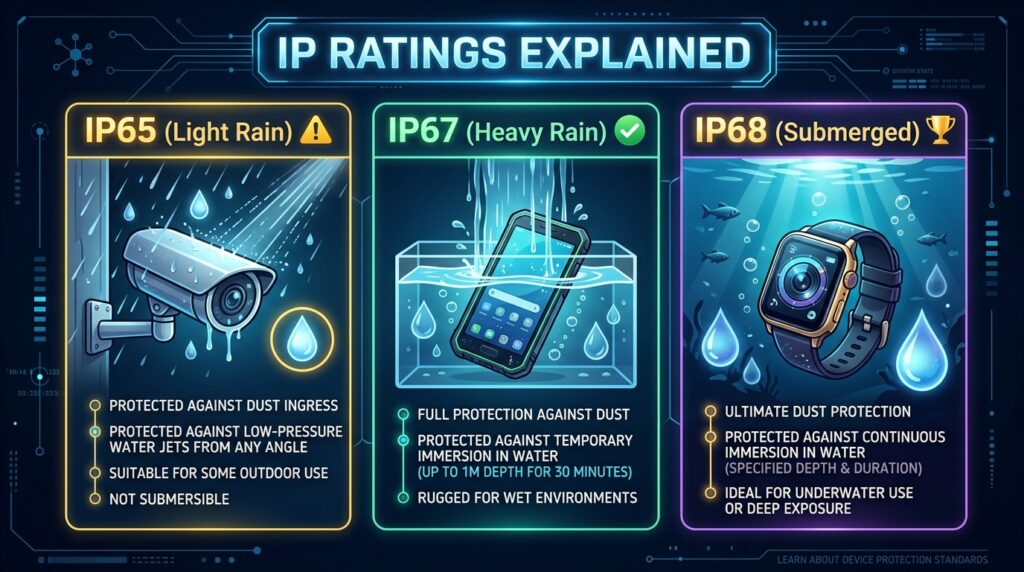
To know if your panel can survive water, you must look for the IP (Ingress Protection) rating. According to the official standards set by the International Electrotechnical Commission (IEC), these numbers dictate exactly how much water your gear can handle.
Here is what those numbers mean for your solar panels:
| IP Rating | What It Means | Rain Survival | Example Brand |
| IP65 | Water-Resistant (Splashes). | ❌ Fails in heavy rain. | Jackery SolarSaga |
| IP67 | Waterproof (Shallow submersion). | ✅ Survives rainstorms. | Premium ETFE Foldable Panels |
| IP68 | Fully Waterproof (Deep submersion). | ✅ Survives monsoons. | EcoFlow Portable |
Crucial Warning: Even if the panel itself is waterproof, the connectors (cables) and the power station are NOT. Never leave your actual battery out in the rain!
2. Fabric (Foldable) vs. Rigid Panels
The build material is the biggest clue to answering the are portable solar panels waterproof question accurately.
- Rigid Panels (Glass/Aluminum): These are the heavy panels you see on RV roofs (like Renogy). They are 100% waterproof and designed to live outside 365 days a year.
- Foldable Portable Panels (Fabric/PET): These are popular for tent camping. Because they are stitched together with canvas or nylon fabrics, water can seep into the seams, short-circuiting the USB ports or the solar cells. Always assume fabric panels are NOT waterproof unless explicitly stated.
3. Brand Reality Check: EcoFlow vs. Jackery
If you are buying a top-tier brand in 2026, you need to know their weather limits before a storm hits.
- EcoFlow (The Waterproof King): Their 110W, 160W, and 220W portable panels are coated in a seamless ETFE film and boast an IP68 rating. You can literally drop them in a river, and they will survive. If you camp in the rain, this is what you need.
- Jackery (The Fair-Weather Friend): The legendary SolarSaga panels are amazing for portability, but they are only IP65 rated. The zippers and the built-in USB ports on the back are highly vulnerable to water damage.
Head-to-Head: We tested both panels in real-world conditions. See the results: Jackery SolarSaga 100W vs EcoFlow 110W.
4. What to Do If Your Panel Gets Wet
If you are still wondering are portable solar panels waterproof after leaving them in a storm, follow these steps immediately to save your gear:
Did you leave an IP65 (non-waterproof) panel out in a thunderstorm? Follow these steps immediately to save it:
- Unplug It Instantly: Do not touch the wet connectors. Unplug the cable from your power station first to save the battery.
- Do Not Fold It: Folding a wet fabric panel traps the moisture inside the seams.
- Wipe and Air Dry: Wipe off standing water with a towel. Leave it open in a dry, warm room for at least 48 hours.
- Test the Output: Once bone-dry, plug it in. If it reads “0 Watts,” the internal wiring may have shorted, or the battery’s BMS is blocking the charge due to lingering moisture in the cable. Test it with a multimeter first before throwing it away.
Troubleshooting: Is your dry panel still not working? Read our repair guide: Why Is My Portable Solar Panel Not Charging?.
5. Buying a Rain-Proof Setup
If you live in the Pacific Northwest or frequently camp in unpredictable weather, you must buy gear designed for water. Do not risk a $300 fabric panel in a storm.
We recently tested the top models on the market specifically for durability and weather resistance.
👉 Check out our results: 5 Best Portable Solar Panels for Camping in 2026.
Final Verdict
So, are portable solar panels waterproof?
Rigid glass panels are. EcoFlow’s IP68 portable panels are. But standard fabric-backed panels (like Jackery) are only water-resistant. Treat your portable solar panels like you treat your laptop: if it looks like rain, pack it inside the tent.
FAQ
Q: Can I leave solar panels out in the winter?
A: Rigid panels can handle snow perfectly. However, portable foldable panels should not be left in freezing temperatures for days, as the plastic coatings (PET/ETFE) can become brittle and crack.
Q: Are the cables and connectors waterproof?
A: MC4 connectors are generally weather-sealed (IP67) when clicked together tightly. However, DC barrel connectors (like 8mm plugs) and USB ports built into the panels are NOT waterproof.
Q: Does rain clean my solar panels?
A: Light rain can wash off loose dust, which improves efficiency. However, heavy rain can leave muddy water spots once dried, which will block the sun. Always wipe them clean with a microfiber cloth.
This is why knowing are portable solar panels waterproof is crucial before you leave them out to get washed.