
Disclaimer: This article may contain affiliate links. As an Amazon Associate, we earn from qualifying purchases at no extra cost to you.
🌍 Note for International Readers: The images in this review feature the US (110V) model. However, our “Check Price” links are smartly geo-targeted. When you click, you will be automatically redirected to the correct local Amazon store (UK, CA, AU) showing the 220V/240V version with your correct local wall plugs.
The EcoFlow RIVER 2 vs BLUETTI EB3A debate is the hottest topic for budget campers in 2026. Both cost under $250, both use long-lasting LFP batteries, and both promise to replace your heavy power banks.
But they have very different strengths.
- EcoFlow is all about simplicity and speed.
- BLUETTI is about features and raw power.
In this head-to-head battle, we compare them side-by-side to help you pick the right one for your weekend trip.
1. Battery Tech & Lifespan (It’s a Tie)
The good news is that you can’t go wrong here. Both units use LiFePO4 (LFP) chemistry.
- EcoFlow RIVER 2: Rated for 3000 cycles to 80%.
- BLUETTI EB3A: Rated for 2500+ cycles to 80%.
- Verdict: Both will last 10+ years of daily use. This is a huge upgrade over older models like the Jackery 240.
Deep Dive: Want to know more about LFP? Read our guide: How Long Does a Portable Power Station Last?.
2. Inverter Power: The Big Difference
This is where the EcoFlow RIVER 2 vs BLUETTI EB3A battle gets interesting.
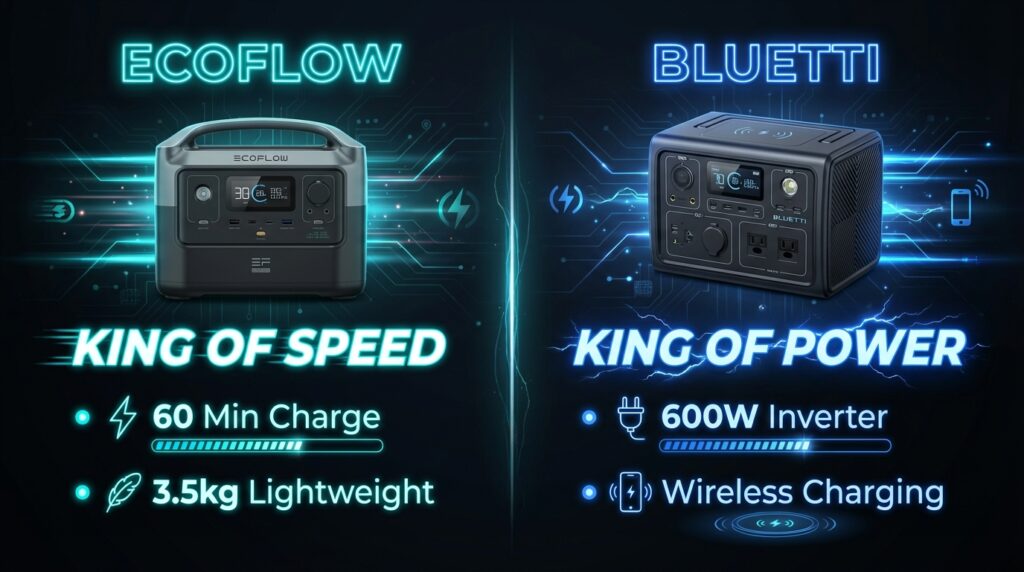
- EcoFlow: Has a 300W inverter (600W Surge with X-Boost). It handles phones and laptops easily, but struggles with small appliances.
- BLUETTI: Has a 600W inverter (1200W Surge). It is twice as powerful. It can run a small blender or a mini-fridge with much less strain.
- Winner: BLUETTI (By a mile). In terms of raw output power, the EcoFlow RIVER 2 vs BLUETTI EB3A winner is clearly BLUETTI due to its 600W inverter.
3. Charging Speed: The Race
We plugged both into the wall to see which one fills up faster.
- EcoFlow: Hit 100% in 60 minutes flat.
- BLUETTI: Hit 100% in 80 minutes (Turbo Mode).
- Winner: EcoFlow. It is still the fastest charging station on the market.
Full Review: See our detailed charging test in the EcoFlow RIVER 2 Review.
4. Portability vs. Features
- Portability: The EcoFlow is lighter (7.7 lbs) and has a better handle design for hiking.
- Features: The BLUETTI is heavier (10.1 lbs) but adds a Wireless Charging Pad on top and a built-in UPS mode.
- Winner: Tie. Choose EcoFlow for hiking, BLUETTI for desk/home use.
Full Review: Interested in the wireless charging? Check the BLUETTI EB3A Review.
5. Pros and Cons Summary
To summarize this EcoFlow RIVER 2 vs BLUETTI EB3A comparison, here is a quick breakdown of where each unit shines and where it falls short.
EcoFlow RIVER 2:
- Pros: Lightest in class (7.7 lbs), fastest charging (60 mins), 5-year warranty.
- Cons: No wireless charging, smaller inverter (300W), loud fan.
BLUETTI EB3A:
- Pros: Powerful inverter (600W), wireless charging pad, built-in UPS mode.
- Cons: Heavier (10.1 lbs), slightly slower charging, app connectivity issues.
Final Verdict: Which One Should You Buy?
Choose EcoFlow RIVER 2 If:
You value portability and speed above all else. It is the perfect “Grab-and-Go” unit for hikers and campers who move a lot.
Choose BLUETTI EB3A If:
You need to power appliances (up to 600W) or want a cheap UPS for your computer. It offers more “Bang for Buck” in terms of features.
FAQ
Q: Can I use solar panels on both?
A: Yes. In our EcoFlow RIVER 2 vs BLUETTI EB3A solar test, we found that BLUETTI charges faster because it accepts up to 200W input compared to EcoFlow’s 110W.
Q: Which app is better?
A: The EcoFlow app is generally more stable and easier to connect via Wi-Fi. The BLUETTI app connects via Bluetooth and is decent but can be buggy.
Q: Which one is quieter?
A: Both have fans that can get loud, but the BLUETTI fan tends to kick in more often, even with light loads.