
Disclaimer: This article may contain affiliate links. As an Amazon Associate, we earn from qualifying purchases at no extra cost to you.
🌍 Note for International Readers: The images in this review feature the US (110V) model. However, our “Check Price” links are smartly geo-targeted. When you click, you will be automatically redirected to the correct local Amazon store (UK, CA, AU) showing the 220V/240V version with your correct local wall plugs.
Choosing between the Jackery SolarSaga 100W vs EcoFlow 110W is the most common dilemma for campers in 2026. You bought a portable power station, and now you want free energy from the sun, but which panel is best?
On paper, the Jackery SolarSaga 100W vs EcoFlow 110W specs look identical, but real-world performance differs.
But in the real world, they are completely different beasts. In this Jackery SolarSaga 100W vs EcoFlow 110W comparison, we reveal which one is actually waterproof, which one sets up faster, and which one belongs in your gear.
1. Build Quality & Waterproofing (The Wet Test)
This is the most critical difference, and where many buyers get confused.
Winner: EcoFlow (Hands down. If you camp in the rain, this is your only choice).
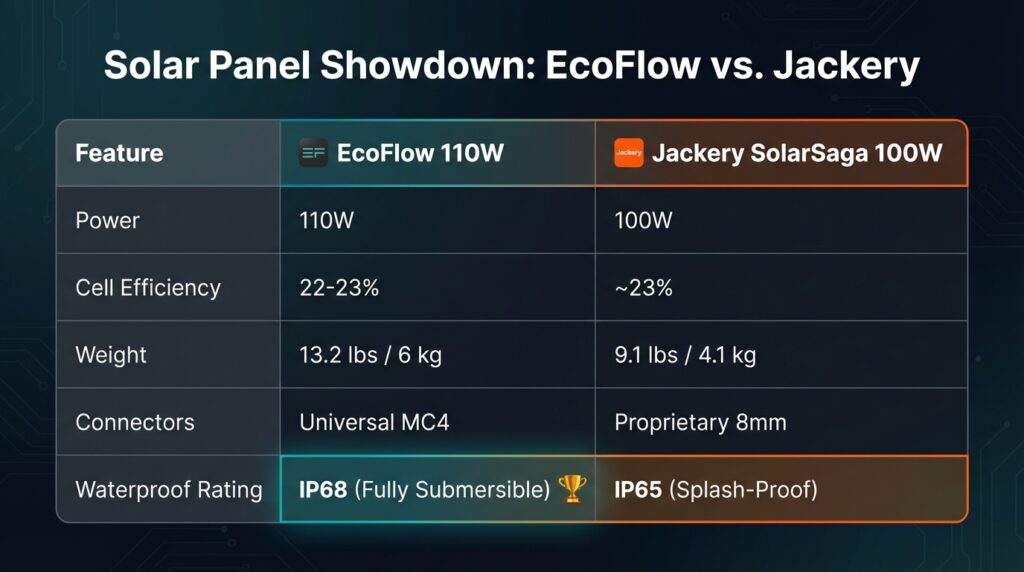
EcoFlow 110W: It is rated IP68. This means it is dustproof and can be submerged in water. It is designed for rugged, wet environments and can be left out in a storm without issues.
Jackery SolarSaga 100W: It is rated IP65. It can handle low-pressure water jets (a splash or light drizzle), but it is NOT waterproof. You cannot submerge it, and the fabric back/USB ports are vulnerable to heavy rain.
2. Portability & Setup: The Ease of Use
How fast can you go from “car trunk” to “charging”?
- Jackery: It folds like a book with magnetic clasps. It has a built-in kickstand that is stiff and easy to deploy. Setup time: 10 seconds.
- EcoFlow: It comes in a zip-case that doubles as a kickstand. It is fiddly and frustrating to set up, especially on uneven ground.
- Winner: Jackery (by a mile). It is much more user-friendly.
Battery Match: If you own a River 2, check our review here: EcoFlow RIVER 2 Review.
3. Charging Efficiency & Output
We tested the Jackery SolarSaga 100W vs EcoFlow 110W output under the same noon sun to see real-world performance.
- EcoFlow: Rated for 110W. In perfect conditions, we saw peaks of 85-90W.
- Jackery: Rated for 100W. We consistently pulled 65-75W.
- Winner: EcoFlow. The Monocrystalline cells seem slightly more efficient, likely due to the extra 10W rating.
Sizing Guide: Not sure if 100W is enough? Use our calculator: How to Choose Portable Solar Panels for Camping.
4. Compatibility: Can I Mix Them?
Many people ask: “Can I use a Jackery panel on an EcoFlow battery?”
- Connectors:
- EcoFlow: Uses standard MC4 connectors (Universal).
- Jackery: Uses a proprietary DC7909 (8mm) barrel plug.
- The Verdict: You CAN mix them, but you need an adapter.
- To use Jackery on EcoFlow: Need DC7909 to XT60 adapter.
- To use EcoFlow on Jackery: Need MC4 to DC7909 adapter.
5. Warranty and Price Value
When analyzing the Jackery SolarSaga 100W vs EcoFlow 110W price-to-performance ratio, both brands offer a standard 24-month warranty.
- Jackery: Excellent customer support in the US.
- EcoFlow: Good support, but the panel is slightly cheaper per watt.
If you treat them well, both panels can last 5+ years, but EcoFlow’s glass coating resists scratches better than Jackery’s ETFE film.
Final Verdict: Which One is Better?
Choose the Jackery SolarSaga 100W If:
You value convenience. The magnetic folding mechanism and built-in kickstand make it a joy to use for quick weekend trips.
- Best For: Jackery Explorer 300 Plus Review owners.
Choose the EcoFlow 110W Panel If:
You are an adventurer who faces rain, snow, or dust. The durability is unmatched, even if the kickstand case is annoying.
- Best For: EcoFlow RIVER 2 Review owners.
FAQ
Q: Does the Jackery panel charge in the shade?
A: No. In this Jackery SolarSaga 100W vs EcoFlow 110W comparison, we found that both panels lose significant power even with small shadows.
Q: Can I chain two panels together?
A: Yes. Both brands support “Series” or “Parallel” connections to double the speed, provided your power station supports the voltage.
Q: Why am I not getting the full 100W?
A: Solar panels rarely hit 100%. Heat, angle, and atmosphere usually reduce output to 70-80% of the rating.