
Disclaimer: This article may contain affiliate links. As an Amazon Associate, we earn from qualifying purchases at no extra cost to you.
Knowing **how to use a portable power station** correctly is critical when the lights flicker and die. Ten years ago, your only option was to fumble for a flashlight or drag a noisy gas generator outside. But in 2026, you likely have a silent battery backup ready to go.
Ten years ago, your only option was to fumble for a flashlight or drag a noisy, smelly gas generator into the backyard. But in 2026, you likely have a portable power station sitting in your closet.
But do you know how to use it correctly when the pressure is on?
Unlike gas generators, battery-powered stations are safe to use indoors, but they require a strategy. If you plug in the wrong appliances, you could drain your battery in 20 minutes.
Here is your step-by-step guide on how to use a portable power station during a power outage safely and efficiently.
Step 1: Safety First (Indoor vs. Outdoor)
One of the most important things to know when learning **how to use a portable power station** is the safety difference compared to gas generators.
- Gas Generators: Must remain OUTSIDE (due to carbon monoxide).
- Portable Power Stations: Can be placed right next to your bed or kitchen counter. They produce no fumes and no noise.
⚠️ Golden Rule: Keep the unit dry. If your power outage is due to a storm or flood, ensure your station is elevated and away from water sources.
Step 2: Prioritize Your “Essentials”
When the grid goes down, your goal isn’t to run the whole house; it’s to run what matters. You need to triage your appliances.
🔴 The “Must-Haves” (Plug these in first):
- Light Source: A small LED lamp (uses very little power).
- Communication: Phone chargers and Wi-Fi routers.
- Medical Devices: If you use a CPAP, this is priority #1. (Read our guide: [Best Portable Power Station for CPAP]).
- Food: Your refrigerator (intermittently).
❌ The “Power Hogs” (Avoid these):
Do not plug in space heaters, hair dryers, or electric stoves unless you have a massive battery. These devices produce heat and will kill your battery life instantly.
Step 3: Rotating the Refrigerator
This is a pro tip that most people miss. You don’t need to keep your fridge plugged in 24/7.
Most modern fridges act like a cooler.
- Plug the fridge into your power station for 1 hour to cool it down.
- Unplug it for 3-4 hours (keep the door closed!).
- Repeat.
This strategy can extend your battery runtime from 6 hours to 24 hours.
(Curious about the math? Read our detailed breakdown: [Can a Solar Generator Run a Refrigerator?]).
Step 4: The “Pass-Through” Charging Trick
If the outage lasts for days, your battery will eventually die. This is where Solar Panels come in.
Most high-quality stations (like the Jackery 1000 v2) support Pass-Through Charging. This means you can connect solar panels to the input port to charge the battery while the battery is powering your phone and fridge at the same time.
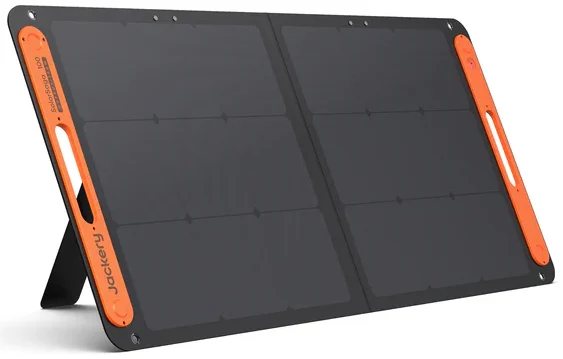
(Check out our review of the [Jackery SolarSaga 100W] to see how efficient solar charging really is).
Which Power Station Do You Need?
If you don’t have one yet, here are the two best options for emergency backup in 2026.
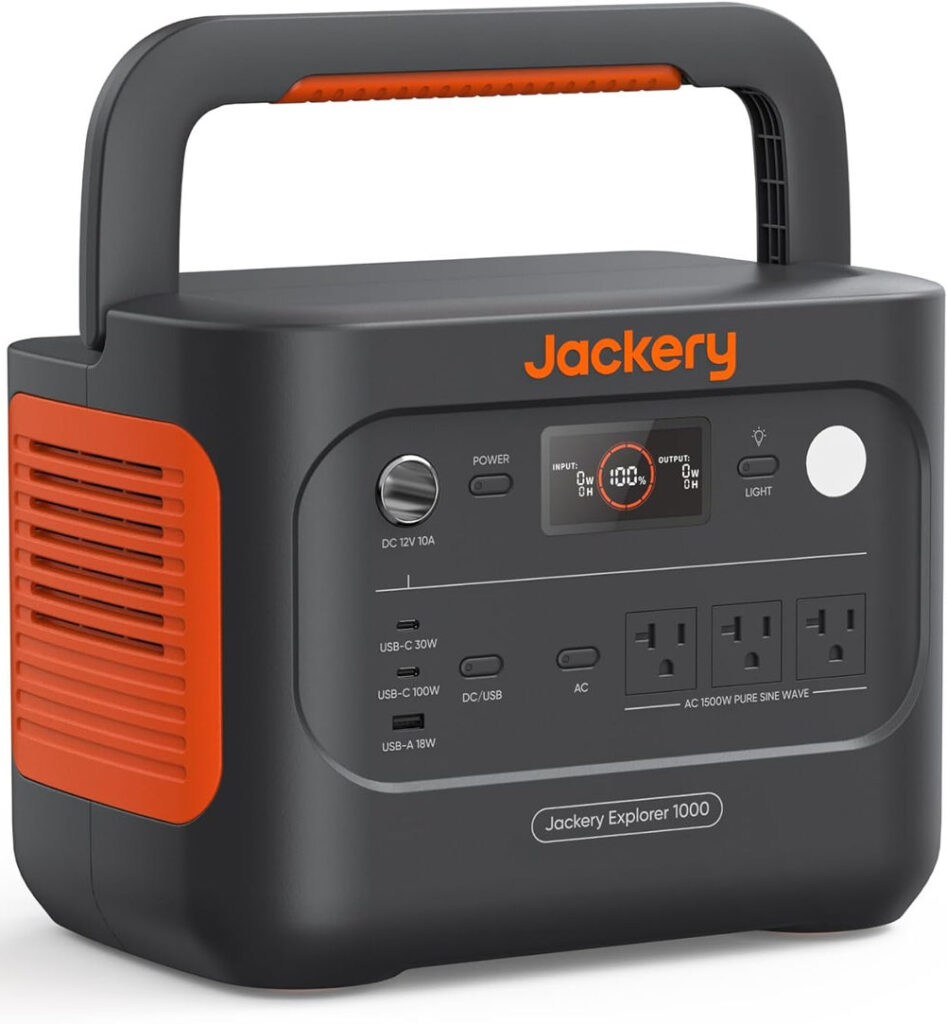
1. The Best for Families: Jackery Explorer 1000 v2
If you need to run a full-size fridge and keep the family phones charged, you need at least 1000Wh (1kWh) of capacity. The v2 is compact, safe, and built for this exact scenario.
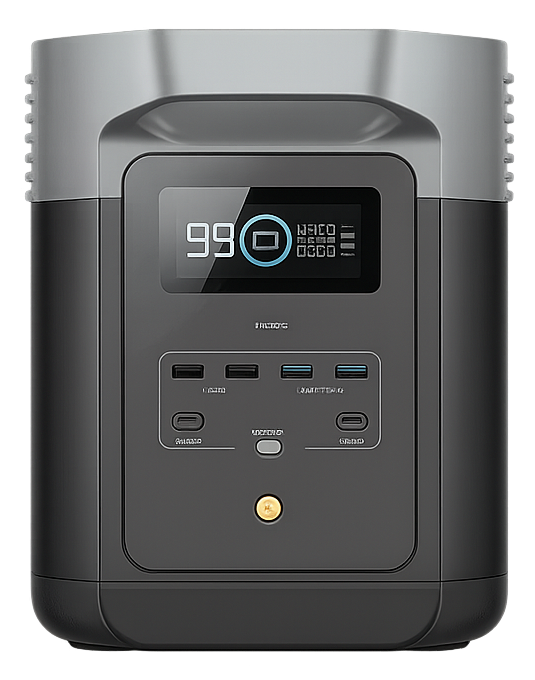
2. The Best for Expandability: EcoFlow DELTA 2
If your outages last for days, the DELTA 2 is smarter because you can buy an “Extra Battery” later to double its capacity without buying a whole new unit. It also charges incredibly fast (80% in 50 mins) when the power briefly comes back on.
Wattage Cheat Sheet: What Can You Run?
To help you plan, here is a quick estimation of how long a 1000Wh station will last with common devices.
| Device | Wattage (Approx) | Estimated Runtime (1000Wh) |
| LED Light | 10W | 80+ Hours |
| Wi-Fi Router | 15W | 50+ Hours |
| CPAP Machine | 40W | 18-20 Hours |
| TV (LED) | 60W | 13-14 Hours |
| Full-Size Fridge | 150W (Average) | 6-10 Hours |
| Space Heater | 1500W | DO NOT USE ( < 30 mins) |
FAQ: How to Use a Portable Power Station Correctly
1. Is it difficult to learn how to use a portable power station?
Not at all. Unlike gas generators, learning how to use a portable power station is as simple as plugging in your phone. Just press the power button, plug in your device, and you are good to go.
2. Can I leave it plugged in all the time?
Yes, most modern units have a BMS (Battery Management System) that prevents overcharging, making them safe to keep plugged in during a storm.
Conclusion: How to Use a Portable Power Station Safely
Surviving a power outage in 2026 isn’t about sitting in the dark; it’s about power management. By keeping your portable power station charged, knowing which devices to plug in, and using solar panels for longer blackouts, you can turn a stressful emergency into a minor inconvenience.