
Disclaimer: This article may contain affiliate links. As an Associate and Direct Partner, we earn from qualifying purchases at no extra cost to you.
🌍 Note for International Readers: The images in this review feature the US (110V) model. However, our “Check Price” links are smartly geo-targeted. When you click, you will be automatically redirected to the correct local Amazon store (UK, CA, AU) showing the 220V/240V version with your correct local wall plugs.
Welcome to our definitive 2026 ecoflow delta pro 3 review. The home backup power station market has traditionally forced buyers into a difficult choice: you either buy a standard 2000W unit that struggles with central air conditioners, or you spend a massive fortune on an oversized 7200W industrial system. There was a massive gap in the middle.
In late 2026, EcoFlow finally solved this dilemma by dropping a masterpiece that instantly earned the “Editor’s Choice” award from major tech publications.
The brand-new DELTA Pro 3 hits the ultimate sweet spot. It delivers a staggering 4000W of continuous power, a massive 4096Wh capacity, and native 120V/240V split-phase output from a single unit. It is the perfect middle-ground for homeowners who want serious disaster protection without buying a massive commercial battery.
In this comprehensive ecoflow delta pro 3 review, we will test its real-world appliance runtimes, evaluate its advanced LiFePO4 chemistry, and help you decide if it is the ultimate gas generator replacement.
1. The Cheat Sheet: 2026 Specs Explained
Before we begin our heavy-duty appliance testing for this ecoflow delta pro 3 review, let’s examine the raw specifications. The numbers reveal an incredibly balanced, high-performance machine.
| ⚙️ Feature | DELTA Pro 3 Specs | 💡 What It Means For You |
| 🔋 Base Capacity | 4,096Wh (4kWh) | Runs a full-size fridge and essentials for 2-3 days. |
| ⚡ AC Output | 4,000W (8,000W Surge) | Easily starts well pumps, heavy tools, and AC units. |
| 🔌 Native 240V | Simultaneous 120V/240V | Hardwire directly to your home panel without extra hubs. |
| ⏱️ UPS Switchover | 10 Milliseconds | Instant power transfer for sensitive desktop PCs. |
| 🧪 Battery Type | LiFePO4 (LFP) | Lasts 4,000 charge cycles (over a decade of daily safety). |
Curious how this compares to massive industrial setups? Read our ranking: 3 Best Whole Home Battery Backup Systems (2026)
2. Unmatched Output: 4000W & Native 240V Power
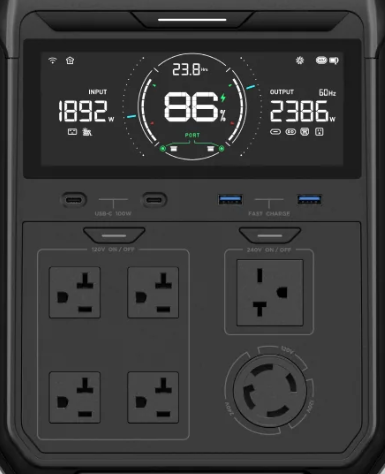
The most striking feature we must highlight in our ecoflow delta pro 3 review is its pure output superiority compared to standard models.
- The 4000W Advantage: While standard home backups top out at 3000W, the DELTA Pro 3 pushes 4000W continuously with a massive 8000W peak surge. This means you can comfortably run a well pump, an electric dryer, and a kitchen refrigerator simultaneously without overloading the inverter.
- Native 240V Output: Older setups required you to buy two separate machines and a messy adapter cable to get 240V power. This unit delivers 120V and 240V natively from a single, streamlined chassis. It features a heavy-duty NEMA L14-30R port, allowing you to connect it directly to your home’s transfer switch.
3. Battery Expansion & Safe Chemistry
Any accurate ecoflow delta pro 3 review must address its long-term off-grid survival capabilities and indoor safety.
- Extreme Expandability: The base 4kWh capacity is huge, but it is highly modular. You can seamlessly stack up to two extra smart batteries on top of the main unit, scaling your total home energy storage up to 12kWh. If you link three full systems together via the Smart Home Panel, you can reach an incredible 36kWh.
- LiFePO4 Safety: Operating massive batteries inside a home requires absolute safety. According to authoritative chemical research (Wikipedia), LiFePO4 cells are the safest on the market, completely resistant to thermal runaway. The DELTA Pro 3 operates silently and emits zero fumes, making it 100% safe for your living room or garage.
Want to know what smaller 2000W units can handle? Read our guide: What Can a 2000W Portable Power Station Run?
4. Charging Speed: X-Stream & Solar Recovery
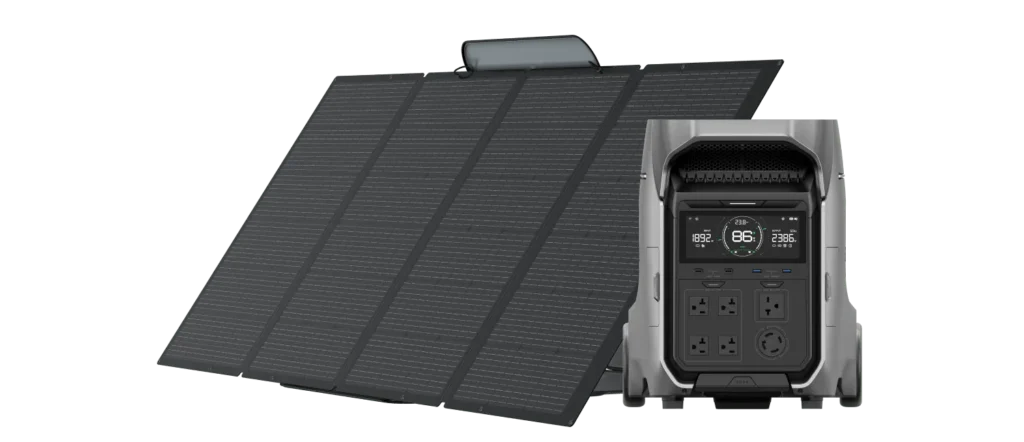
When the grid goes down for days, how fast can you recover? Off-grid charging speeds are a massive focus in this ecoflow delta pro 3 review.
- Wall Charging: Using a standard AC wall outlet, EcoFlow’s industry-leading X-Stream technology recharges this massive 4kWh battery from 0% to 80% in just under an hour.
- Dual Solar Input: It features an incredibly advanced dual-port MPPT solar controller capable of accepting up to 2600W of solar input. If you connect heavy-duty rigid or portable solar arrays, you can completely recharge the battery off-grid in about two hours of peak sunlight.
Final Verdict: Is It The Ultimate Sweet Spot?
To wrap up our definitive 2026 ecoflow delta pro 3 review, we can confidently state that EcoFlow has built an absolute masterpiece for the modern homeowner.
If you are just looking for a weekend camping battery, this unit is overkill. However, if you are a homeowner seeking a permanent, silent, and fume-free insurance policy against grid failures, the DELTA Pro 3 is unmatched. By perfectly balancing a 4000W output, native 240V integration, and a highly competitive price point compared to the 7200W Ultra models, the EcoFlow DELTA Pro 3 is hands-down the smartest whole-home investment of the year.
Curious about the older, smaller model? Check out our legacy review: EcoFlow DELTA Pro Review (2026): The Massive Price Drop!
FAQ
Can the model in this ecoflow delta pro 3 review run a central air conditioner?
Yes. Because it outputs 4000W continuously and natively supports 240V split-phase power, it has the surge capability to safely start and run most standard central air conditioning units or heavy RV air conditioners.
Is it safe to leave plugged in as a UPS according to this ecoflow delta pro 3 review?
Absolutely. It features a highly responsive 10ms Uninterruptible Power Supply (UPS) function. You can leave your sensitive electronics (like desktop computers or CPAP machines) plugged into it continuously. If the grid fails, it switches to battery power instantly.
Can I charge it using third-party solar panels?
Yes. The built-in MPPT controllers accept third-party solar panels as long as your solar array stays within the unit’s maximum input voltage (Voc) limits. You will simply need the correct MC4 to XT60i adapter cables.